- The H3C was announced on 3 November 2026. This guide explains official documentation; Nanopack has not tested the printer.
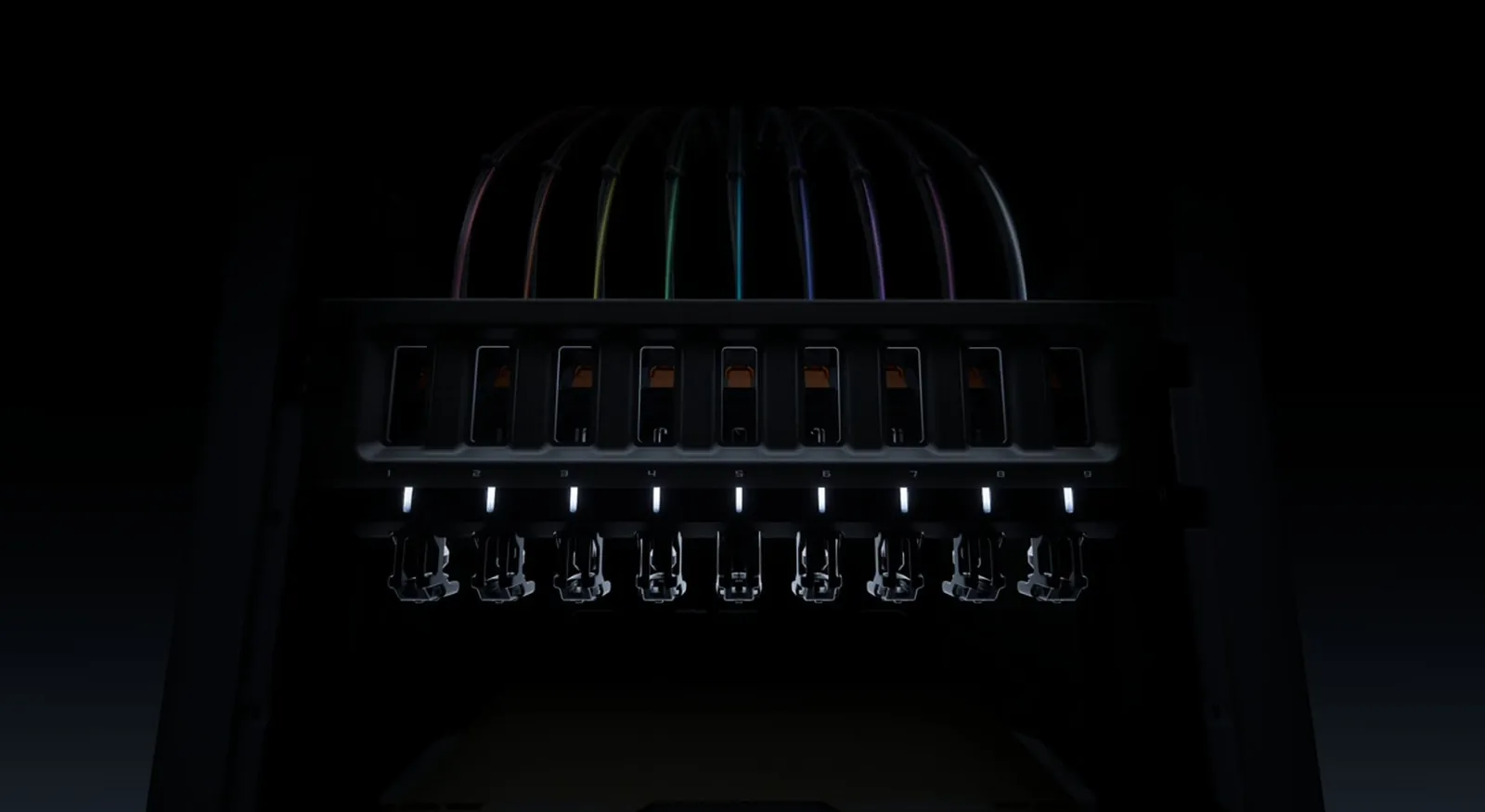
- Swaptek keeps separate tools loaded with filament. Bambu Lab claims changes in less than six seconds; actual job savings need checking on your own model.
- Mixed nozzle sizes can give a detailed region thin layers while a larger region uses thicker layers.
- Feed capacity, drying capacity and expanded material count are different specifications. Check the required drying cycle for each spool.
- Separate tools do not guarantee that different polymers bond or share a suitable processing window.
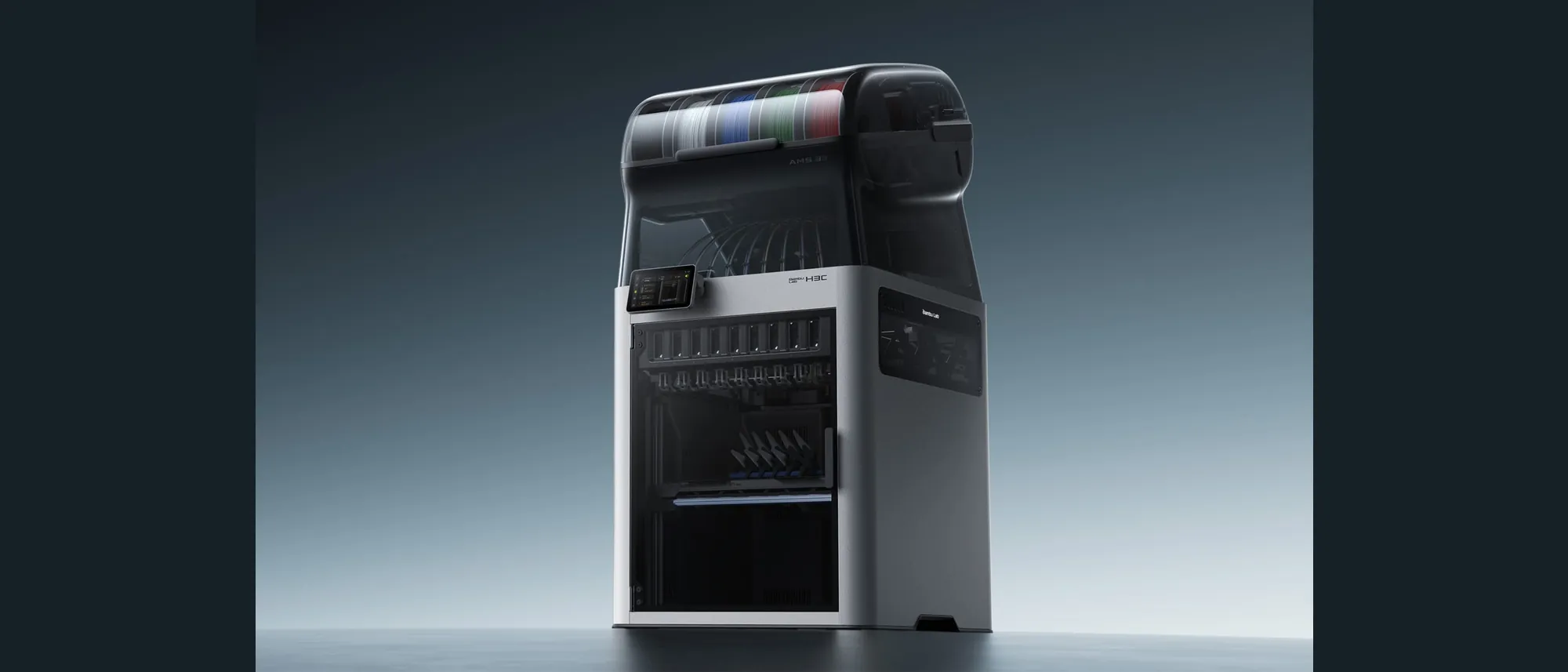
Bambu Lab's new H3C is a tool-changing 3D printer announced on 3 November 2026. Its significance for materials work is straightforward: separate filament paths let a part use different polymers without repeatedly flushing one shared nozzle. That makes support interfaces, soft sections and local changes in nozzle size more interesting than a longer colour list.
This is a source-based explanation, not a hands-on review. Nanopack has not tested an H3C. The specifications below come from Bambu Lab's launch documentation, checked on 17 November 2026; performance claims remain the manufacturer's claims. For the underlying polymers, start with our 3D printing filament types guide.
Bambu Lab H3C specifications and launch price
The official launch announcement lists the following hardware limits. A maximum temperature describes the machine, not the right setting for every spool.
| Item | Published specification |
|---|---|
| Build volume | 330 × 320 × 325 mm |
| Print tools | Nine, with separate filament paths and heaters |
| Maximum nozzle temperature | 350 °C |
| Maximum bed temperature | 120 °C |
| Active chamber heating | Up to 65 °C |
| Supported nozzle diameters | 0.2, 0.4, 0.6 and 0.8 mm |
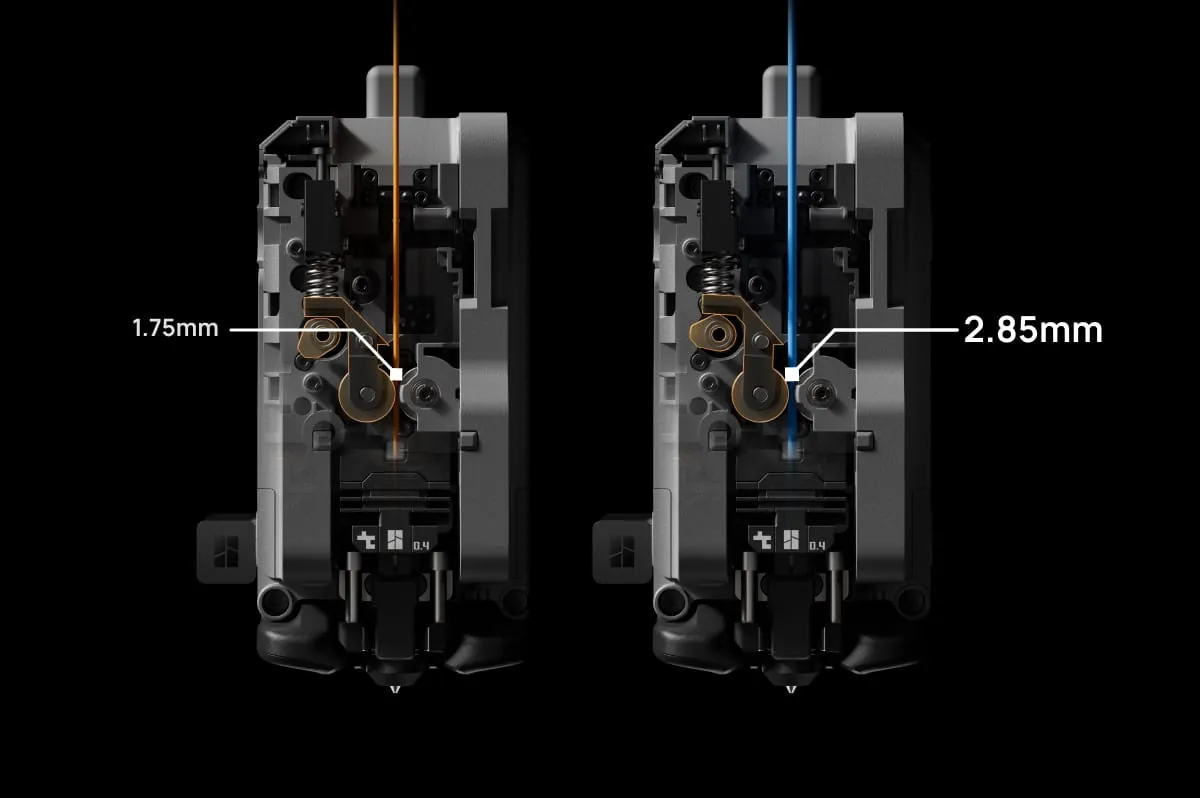
| Supported filament diameters | 1.75 and 2.85 mm |
| Included nozzle material | Hardened steel |
| External dimensions | 493 × 571 × 587 mm |
| Weight including AMS 3H | 36.28 kg |
| H3C with AMS 3H: US launch price | US$2,499 before tax |
| H3C with AMS 3H: EU launch price | €2,499 including tax |
| H3C with AMS 3H: UK launch price | £2,199 including tax |
These are dated launch prices, not a live quotation. Regional stock, delivery charges, promotions and bundle contents need checking in the official store before ordering.
How Swaptek changes materials
Bambu Lab's Swaptek explanation describes independent tools that retain their loaded filament. Active Pre-Heat reads ahead in the G-code and warms the next tool while the current one prints. The company claims a print-to-print change in less than six seconds, including a short priming sequence. We have not measured that interval.
The important distinction is between swapping the tool and changing the filament inside a shared melt path. Keeping a tool assigned to a material avoids the repeated unload, reload and flushing cycle at that boundary. It does not establish that a finished job uses no waste. Priming, failed parts and any structures requested by the slicer still belong in the material budget.
For a useful comparison, slice your own model and record total time and total filament, including anything outside the part. A single-material enclosure with a small label and a figurine changing colour on every layer have very different switching costs. Our 3D print cost calculator can turn those estimates into a comparable cost using your own spool and electricity prices.
Which materials make sense on the H3C?
Choosing a polymer still comes before choosing a slot. Treat the following as a job-planning checklist, not a list of tested H3C profiles. Our PLA, PETG, ABS and ASA comparison explains the heat, weathering and stiffness trade-offs behind the choice.
| Job | What to check | Nanopack reference |
|---|---|---|
| Decorative PLA part | Colour placement, support removal and the cost of extra tool changes | Filament types and uses |
| PETG functional part | Dryness, plate release and surface finish | PETG settings |
| ABS or ASA housing | Chamber conditions, shrinkage and ventilation | ASA settings |
| Flexible section | Exact TPU grade, diameter, feed path and how it attaches to the rigid region | TPU settings and hardness |
| Fibre-filled component | Grade-specific drying, nozzle restrictions and print orientation | Filled filament trade-offs |
| Engineering polymer | Whether the grade's complete processing window fits the machine | Engineering filament requirements |
Separate nozzles address delivery and contamination. They do not guarantee that two polymers bond, shrink together or tolerate the same chamber conditions. For a rigid part with a soft grip, print a small joint sample first. Consider a mechanical interlock when the design cannot rely on adhesion alone. That is a design recommendation, not a measured H3C result.
A support interface has the opposite requirement: it should separate cleanly. Test the intended model/support pair on a small overhang before committing to a long build. Keeping a dry support spool ready is useful only if the interface actually releases the way the part needs.
Mixed nozzle sizes: detail where it matters
The H3C can assign different nozzle diameters to different regions of a print. Bambu Lab's mixed-nozzle slicing explanation also describes different layer heights across adjacent regions. Its slicer groups the work into layer bands so several thin layers can meet one thicker layer at a common height.
In Bambu Studio, the company describes assigning regions with painting or modifier boxes. That is useful for a large body with a small relief, dial or lettering area: the fine region need not dictate every extrusion elsewhere. This is a software capability as well as a tool-changing capability; fitting different nozzles alone does not provide the same scheduling.
Check the preview at the boundary between regions. Look at tool assignments, layer transitions and estimated time before printing. A large region that gains little from a finer nozzle is a poor place to spend extra tool changes. Conversely, assigning a coarse nozzle to small lettering defeats the reason for separating the regions.
Nozzle diameter also does not tell you the hot end's sustainable flow for a particular material. Use our volumetric flow calculator to relate line width, layer height and speed, then compare that demand with a validated profile for the actual filament and nozzle.
Flexible parts and colour mixing
Bambu Lab describes FlexFeed support for dedicated 2.85 mm TPU down to 75A. This does not make every older TPU profile or AMS compatibility rule transferable to the H3C. Confirm the exact material and feed configuration.
In its application examples, Bambu Lab shows a watch using a fine nozzle for the dial, another for a fibre-filled body and a separate tool for a TPU strap. It also describes combining flexible materials of different hardness in one component. These demonstrate intended workflows; they do not establish the durability of your own material pair.
The same article describes colour blending by arranging layers of cyan, magenta, yellow, black and white filament. This is deposited-colour layering, so do not read it as a guarantee that arbitrary spools produce a calibrated colour match. Surface geometry, translucency and the chosen colour profile are sensible things to evaluate on a sample.
For a wearable, judge the joint and the surface as carefully as the appearance. Check the filament maker's documentation for the intended contact and use conditions. A successful print is not, by itself, evidence that a material is suitable for prolonged skin contact or another demanding application.
AMS 3H: drying capacity and material count
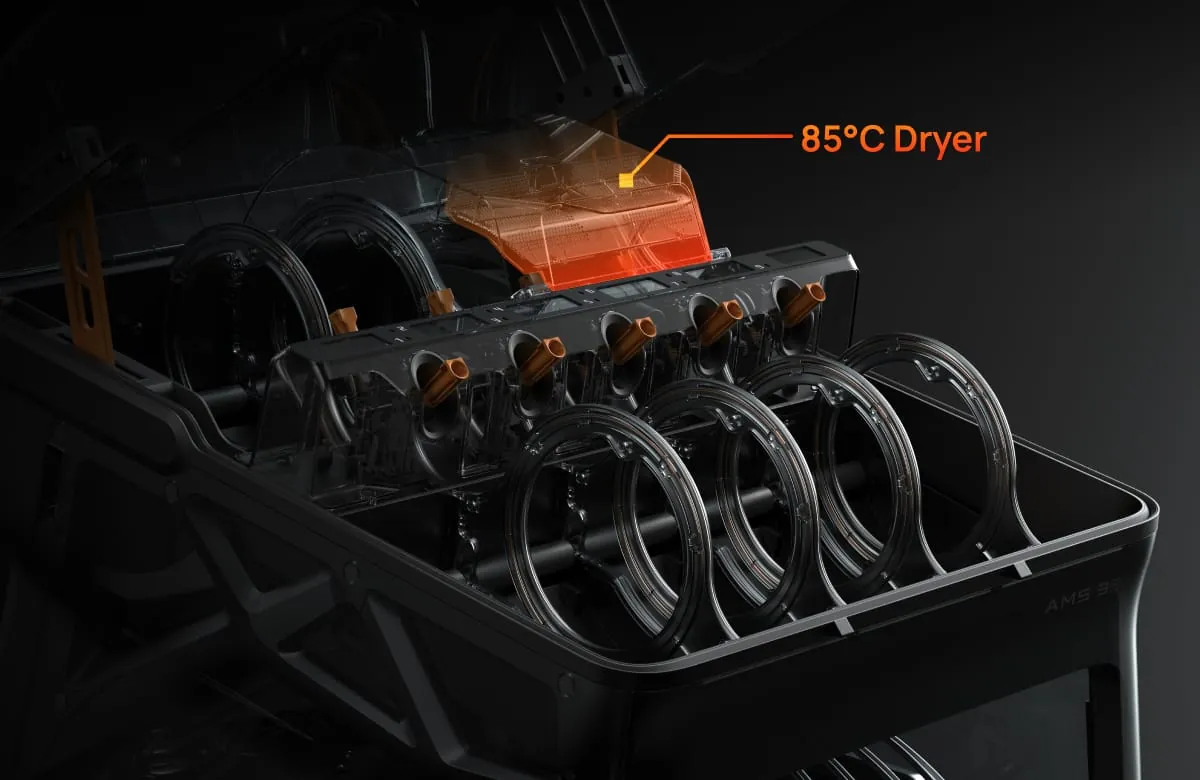
The launch documentation describes nine feed slots, two dedicated drying slots reaching 85 °C, and drying while printing. It also says older AMS hardware connected through tool 1 can expand a job to 24 materials. Those figures describe different things: feed paths, drying capacity and an expanded material count.
Do not budget for nine spools all receiving their own full drying cycle at once. Nor should an 85 °C dryer be assumed to cover every engineering grade. Match the spool's specified drying temperature and duration to the hardware; use the manufacturer's storage guidance after drying.
Our filament drying guide covers the material requirements. The separate AMS 2 Pro and AMS HT guide covers those older units. Its settings are not an AMS 3H instruction sheet. Check the H3C documentation for the permitted spool, inlet and drying arrangement rather than transferring a similarly named product's procedure.
For a long job, prepare a spool plan before slicing: material, colour, diameter, tool assignment, required drying and remaining mass. This simple list catches a more practical problem than the headline material count: discovering halfway through that the correct dry spool is not available.
Heated chamber, build surface and emissions
For an engineering print, compare all the required temperatures together: nozzle, bed and chamber. A hot nozzle cannot compensate for a chamber below the grade's specified range. A material family name also does not identify a formulation; two filled nylons can require different preparation and processing conditions.
Use the grade's profile as the starting point and treat a flat test coupon as a check on adhesion and shrinkage before a large housing. Our warping guide covers cooling stress and corner lift. The smooth vs textured PEI comparison explains why more adhesion is not always better when a part needs to release without damaging the sheet.
For indoor operation, assess the room and the material as well as the enclosure. Our 3D printer emissions guide separates particles from volatile compounds and explains what different filters address. A filter specification alone does not establish the air quality at your desk.
H3C versus keeping an H2D, H2C or X2D
Bambu Lab has announced mixed-nozzle software work for existing models. Its estimated schedule lists H2D support without a filament track switch for November 2026, H2C and X2D for February 2027. With a track switch, it lists February 2027 for H2D and March 2027 for H2C and X2D.
These are development estimates, not confirmation that an update is installed or available today. Check the release notes for your printer and configuration. An announced feature is a reason to check your current machine's options before buying replacement hardware.
For an existing owner, the useful comparison is a representative job. Slice the same design with the same materials and quality target, then compare predicted time, total material, preparation and accessory cost. Do not assume a different architecture saves enough on a single-material workload to justify replacement.
When the H3C deserves a closer look
The H3C is most relevant to a workflow that repeatedly needs material boundaries: removable support interfaces, soft and rigid regions, or small detailed zones on a larger part. A workshop printing one polymer through one nozzle should first identify what it cannot achieve with its current equipment.
Before ordering, gather a small set of real models and check the required material profiles, complete bundle contents, drying plan and workspace. Ask for a representative sample if the purchase depends on a difficult interface or surface finish. Manufacturer demonstrations identify possibilities; your own acceptance part establishes whether those possibilities solve your job.
Frequently asked questions
When was the Bambu Lab H3C announced?
Bambu Lab announced the H3C on 3 November 2026. This guide was checked against official documentation on 17 November 2026.
How much does the Bambu Lab H3C cost?
The published H3C with AMS 3H launch prices were US$2,499 before tax, €2,499 including tax and £2,199 including tax. These are dated announcement prices; check the regional store for a current quotation.
Does Swaptek mean zero filament waste?
No zero-waste conclusion follows from the mechanism. Separate paths avoid flushing a shared nozzle at that material boundary, but priming and any extra structures in the sliced job still count toward material use.
Can I use older AMS drying settings for the AMS 3H?
Check the AMS 3H instructions rather than transferring another unit's procedure. Match drying to the exact filament grade, spool and permitted configuration.
Has Nanopack reviewed an H3C in person?
No. This is a source-based guide to manufacturer specifications and their implications for materials work, not a hands-on review or a measured performance comparison.