- All three data sheets allow 240-260 °C at the nozzle: Prusament gives 250 ± 10 °C, Polymaker and Bambu Lab 230-260 °C. Prusa's own guide prints cooler, at 230 °C for the first layer and 240 °C after.
- Bed figures share only 70-75 °C: Bambu Lab 65-75 °C, Polymaker 70-80 °C, Prusament 80 ± 10 °C. Prusa warns that PETG on smooth PEI can damage the sheet, so use glue stick there or a textured sheet.
- The fan is the widest gap: off to 20% for Polymaker, 50% for Prusament, 0-60% for Bambu Lab. Prusa suggests no fan on the first layers, then half power, and fan off for maximum toughness.
- Retraction: 1-3 mm at 20-40 mm/s from Polymaker, 0.4-0.8 mm at 30-60 mm/s from Bambu Lab. Prusa ties stringing to retraction and nozzle temperature.
- Across the layers, Polymaker's PETG keeps 42.8 of its 50.8 MPa tensile strength and Bambu PETG Basic 35 of 51 MPa. Prusa measures 18 MPa interlayer adhesion for its PETG.
- Drying: 55 °C for 6 h (Prusa), 65 °C for 6 h (Polymaker), 65 °C for 8 h in a forced air oven (Bambu Lab). No maker requires an enclosure for PETG.
Set the nozzle to 240-250 °C for a first PETG print. The data sheets of Prusament, Polymaker and Bambu Lab all allow 240-260 °C, so that is the safe zone. Put the bed at 70-80 °C and use glue stick on smooth PEI. Run the part cooling fan low, somewhere between off and 50%, and keep retraction short. PETG does not need an enclosure. If a spool has been open for weeks, dry it at 55-65 °C for 6 to 8 hours first. Fan speed is where the three makers part ways most: Polymaker allows no more than 20%, Bambu Lab goes to 60%, and Prusament sets a fixed 50%.
We took these numbers from the three companies' technical data sheets, plus Prusa's material guide and drying table, all read on 14 October 2026. Prusament PETG, Polymaker PolyLite PETG and Bambu PETG Basic are separate products with their own formulations, even though their densities are close (1.27 g/cm³ for Prusament, 1.25 for the other two). If you are still choosing a filament, the PLA vs PETG vs ABS comparison covers that question, and the ASA settings page treats ASA the same way this page treats PETG. Nanopack has no business relationship with any of these manufacturers.
PETG settings by manufacturer
| Setting | Prusament PETG | Polymaker PolyLite PETG | Bambu PETG Basic |
|---|---|---|---|
| Nozzle | 250 ± 10 °C | 230-260 °C | 230-260 °C |
| Bed | 80 ± 10 °C | 70-80 °C | 65-75 °C |
| Surface | Satin or powder coated sheet; smooth PEI with glue stick | PC or textured PEI, glue when needed | Cool Plate SuperTack, textured or smooth PEI, glue recommended |
| Part cooling fan | 50% | Off to 20% | 0-60% |
| Speed | Up to 200 mm/s | 50-100 mm/s | Under 200 mm/s |
| Retraction | Not given | 1-3 mm at 20-40 mm/s | 0.4-0.8 mm at 30-60 mm/s |
| Enclosure | Not mentioned | Not needed | Chamber at 35-50 °C |
| Drying | 55 °C, 6 h (Prusa's drying table) | 65 °C, 6 h | 65 °C, 8 h (forced air oven) |
| Test bars printed at | 250 °C nozzle, 80 °C bed, 200 mm/s | 240 °C nozzle, 80 °C bed, fan off, room air | 255 °C nozzle, 70 °C bed, 150 mm/s |
All three companies made their test bars in the middle of their own ranges, which is different from ASA, where the bars came from near the top. So the strength figures on these sheets describe a part printed at roughly 240-255 °C. Polymaker's bars were also printed with the fan switched off.
Nozzle temperature
The three ranges overlap almost completely. Prusament's 250 ± 10 °C spans 240 to 260 °C, and Polymaker and Bambu Lab both state 230-260 °C. Prusa's own guide recommends something cooler than its data sheet: 230 °C on the first layer and 240 °C for every layer after that. In the same guide Prusa says stringing can be reduced with a lower nozzle temperature and longer retraction. Those two settings pull against each other, since hotter plastic bonds better between layers and cooler plastic oozes less. It is worth printing a temperature tower from 230 °C to 260 °C on each new brand before settling on a number.
Bambu Lab's filament guide has a PETG column that gives 240-270 °C, and the current PETG Basic data sheet gives 230-260 °C. The v3.0 sheet describes PETG Basic as an upgraded formula that strings less, which may explain the gap. An older spool may match the guide better than the current sheet.
Bed temperature and build surface
The bed figures sit lower than the nozzle figures and agree less. Bambu Lab specifies 65-75 °C, Polymaker 70-80 °C, and Prusament 80 ± 10 °C, so the only band all three share is 70-75 °C. Prusa's guide again departs from its sheet: 85 °C on the first layer and 90 °C after that.
On a PETG first layer, the usual trouble is a print that sticks too well. Prusa's guide warns that printing PETG on a smooth PEI sheet can damage the sheet, and recommends the textured powder coated or satin sheets. If you do use smooth PEI, apply glue stick first, so the plastic bonds to the glue and comes off without tearing the surface. Prusament's data sheet uses the same footnote. Polymaker says glue "when needed" on PC or textured PEI, and Bambu Lab recommends glue stick or liquid glue on each of its three listed plates. Prusament adds that a brim is generally not necessary, which matches Prusa's description of PETG as a material that barely shrinks or warps.
Fan speed, retraction and stringing
PETG strings more than PLA, and both Prusa and Bambu Lab write about it. Prusa's list of drawbacks includes stringing, weak bridges and overhangs, prints that cling to the bed, and supports that are hard to remove. Bambu Lab's data sheet claims less stringing for the reformulated PETG Basic and rates the material for overhangs up to about 70° and bridges of about 30 mm.
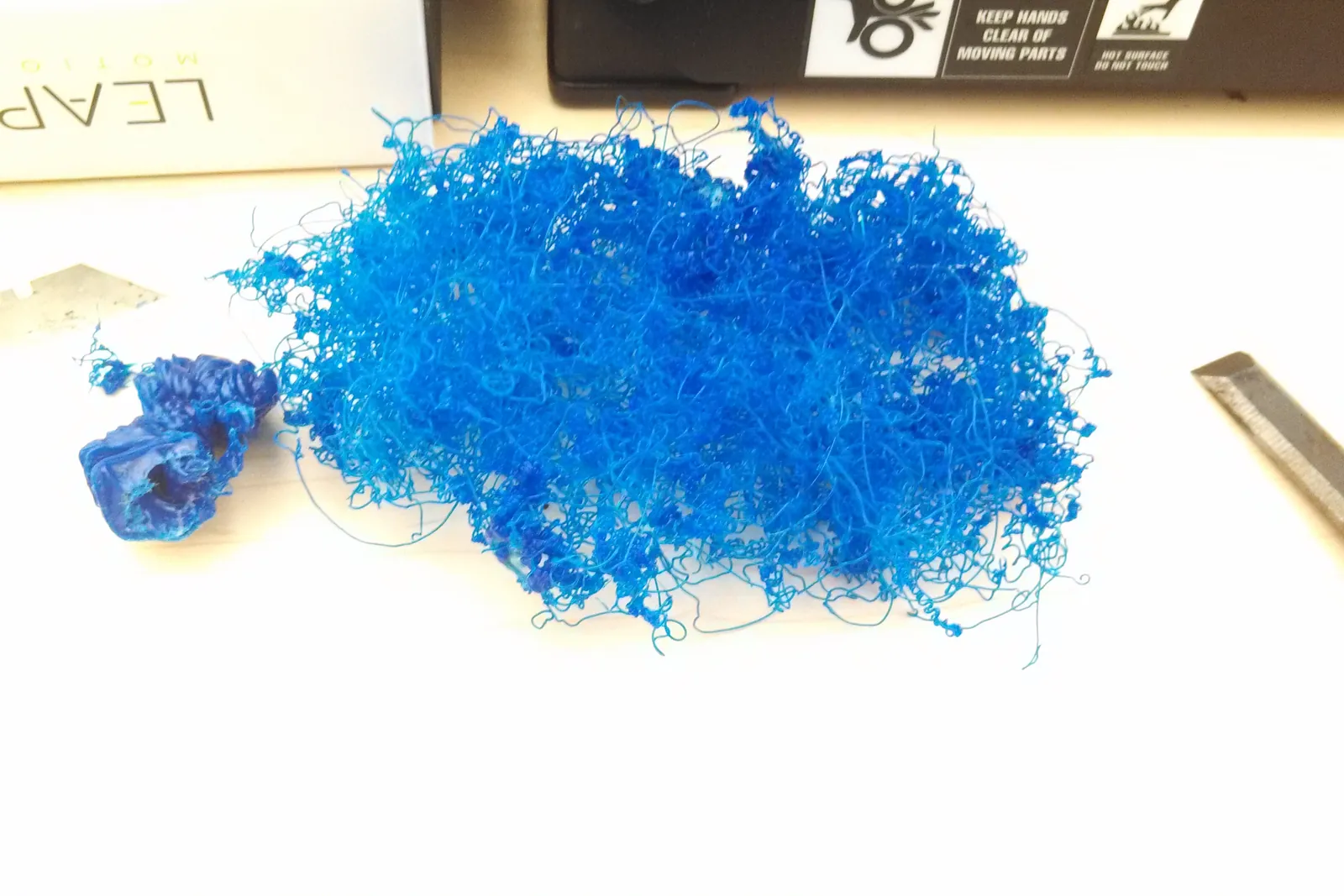
Retraction advice falls into two camps. Polymaker suggests 1-3 mm at 20-40 mm/s. Bambu Lab suggests 0.4-0.8 mm at 30-60 mm/s. Neither sheet names an extruder type. Retraction length depends on how far the filament travels between the drive gear and the nozzle, so a Bowden printer is more likely to need the longer figure. Prusa gives no retraction number at all and leaves it to the slicer profile.
Prusa's guide says PETG needs cooling, then says in the same article that for maximum toughness you should try printing with the fan off, and it proposes a compromise: no fan for the first few layers, then half power. Polymaker's 20% ceiling and its fan off test bars point the same way. Bambu Lab's 0-60% is the most permissive range. More air gives cleaner overhangs and shorter strings, while less air gives better bonding between layers. On parts that carry load, start with the fan low and add cooling only for the features that need it.
How strong the layers are
PETG bonds between layers better than ASA, but Z strength still falls below XY. Prusa Polymers measures interlayer adhesion of 18 ± 4 MPa for its PETG, against 11 MPa for its ASA in the same test. That compares with a tensile yield of 46 ± 1 MPa for the filament itself.
| Property | Polymaker PolyLite PETG | Bambu PETG Basic |
|---|---|---|
| Tensile strength, XY | 50.8 ± 0.9 MPa | 51 ± 1 MPa |
| Tensile strength, Z | 42.8 ± 2.8 MPa | 35 ± 6 MPa |
| Elongation at break, XY | 8.4 ± 1.7% | 9.5 ± 0.7% |
| Elongation at break, Z | 3.3 ± 0.2% | 5.2 ± 1.4% |
| Impact strength, XY | 2.6 ± 0.2 kJ/m² (notched Charpy) | 34.2 ± 4.1 kJ/m² |
| Impact strength, Z | Not given | 10.5 ± 1.8 kJ/m² |
Polymaker's Z bars keep 84% of their XY tensile strength. Bambu Lab's keep about 69%, and the ± 6 MPa spread shows how much the result varied between bars. The two impact rows cannot be compared with each other, because Polymaker reports a notched test and Bambu Lab does not say which variant it used. In Prusament's Charpy test, unnotched PETG bars did not break at all.
Heat resistance and moisture
On the heat numbers the brands spread further apart than on the print settings. Polymaker measures a glass transition of 81 °C, a Vicat softening point of 84 °C and an HDT of 78 °C at 0.45 MPa. Bambu Lab gives 69 °C, 69 °C and 71 °C for the same three tests. Prusament publishes an HDT of 68 °C at both 0.45 and 1.80 MPa. Prusa rates PETG for most outdoor use where temperatures stay below 80 °C. Going by Bambu Lab's figures, a part made from that brand would start to soften about ten degrees below that limit.
PETG absorbs very little water. Prusament reports 0.07% after 24 hours and 0.10% after seven days, at 24 °C and 22% humidity. Bambu Lab's saturated value is 0.45% at 25 °C and 55% humidity, while the PETG column of its older filament guide says 0.32%. Bambu Lab wants the filament printed and stored below 20% humidity, in a sealed box with desiccant. Polymaker recommends its PolyBox and the resealable bag the spool ships in.
Drying PETG
| Source | Method | Temperature | Time |
|---|---|---|---|
| Prusa drying table (all PETG versions) | Not specified | 55 °C | 6 h |
| Polymaker PolyLite PETG data sheet | Not specified | 65 °C | 6 h |
| Bambu PETG Basic data sheet v3.0 | Forced air oven | 65 °C | 8 h |
| Bambu PETG Basic data sheet v3.0 | Printer bed, X1, P and H2 series | 80 °C | 12 h |
| Bambu PETG Basic data sheet v3.0 | AMS 2 Pro and AMS HT | 65 °C | 8 h |
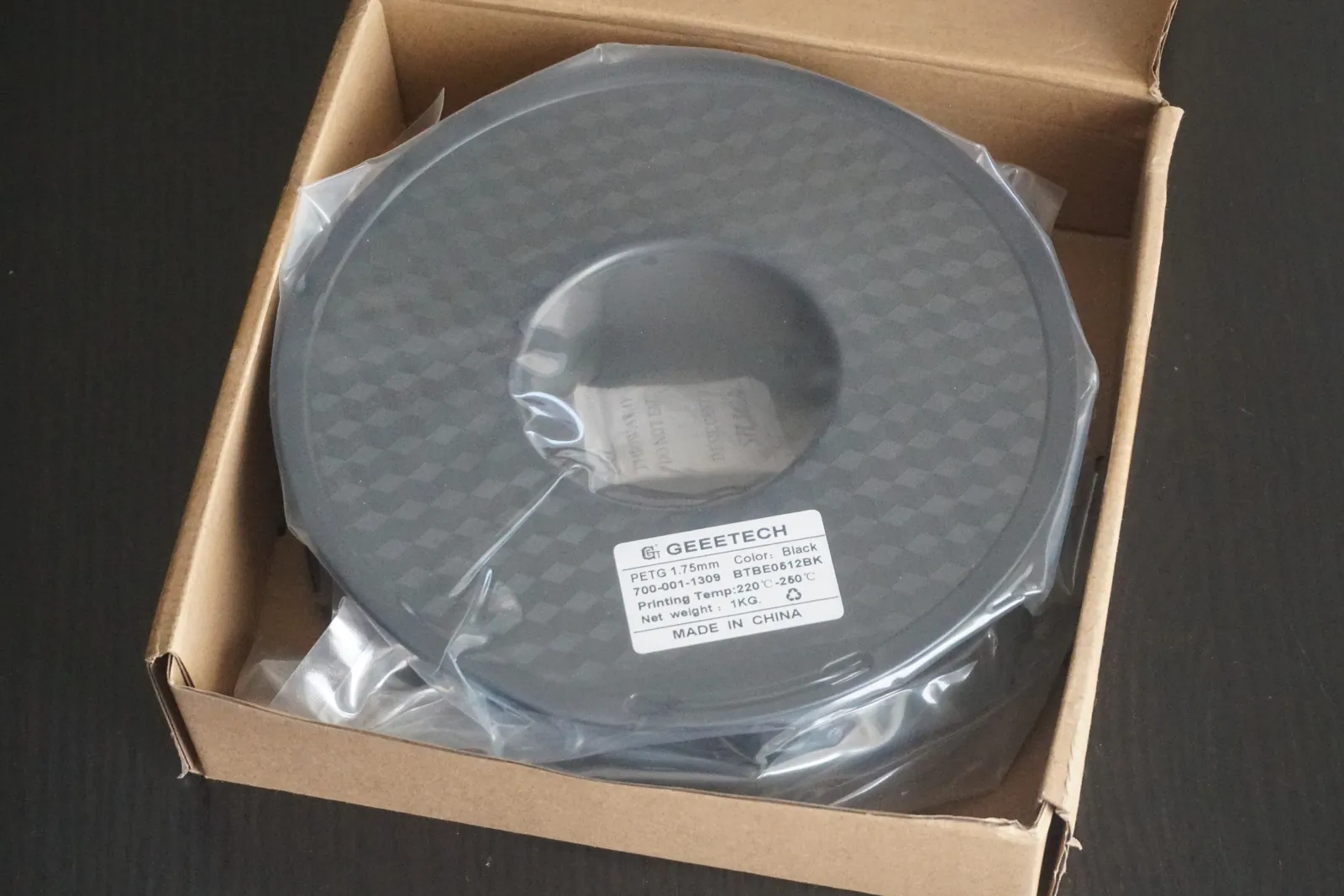
Prusa's 55 °C is 10 °C below the others, probably because of its spools. Prusa says older black Prusament spools can loosen above 45 °C and need a screw to hold them together during drying. Bambu Lab ships PETG Basic on an ABS spool rated to 70 °C, so its 65 °C oven setting stays just below that limit. Bambu Lab also rules out microwaves and kitchen ovens and asks that the spool be kept away from the heating element.
The AMS figure in the data sheet is 8 hours. Bambu Lab's AMS drying table gives PETG 12 hours at the same 65 °C, as the AMS 2 Pro and AMS HT drying guide shows. PETG is also the material that forces PLA and TPU out of the unit before a cycle starts. The general filament drying guide explains how to tell when a spool needs drying in the first place.
Annealing, supports and finishing
Bambu Lab advises against annealing PETG Basic. In its view the gain in properties is very limited, and parts with anything other than a simple shape can deform noticeably. If you anneal anyway, it suggests 60-70 °C for 6 to 12 hours in a forced air oven. For supports, Bambu Lab offers its Support for PLA/PETG, and Polymaker recommends PolyDissolve S1. According to Prusa, PETG sands easily both wet and dry. For chemical smoothing Prusa names only dichloromethane, and it considers that practical only in a laboratory.
Where the documents disagree
Prusa's two documents give different numbers. The Prusament data sheet gives 250 ± 10 °C at the nozzle and 80 ± 10 °C on the bed. The PETG article in its knowledge base gives 230/240 °C and 85/90 °C for the first and later layers. That puts the guide's nozzle setting at the bottom of the sheet's range and its bed setting near the top. Both can be right, since the guide covers PETG in general and the sheet covers one product.
Bambu Lab's documents differ on nozzle temperature, and its two AMS documents differ on drying time. On enclosures, Polymaker says a closed chamber is not needed, Prusa's guide recommends PETG for large models because it does not warp, and Bambu Lab's sheet still lists a chamber temperature of 35-50 °C. On an open printer, the settings in the first section are the ones to follow. Bambu Lab's chamber figure works better as a ceiling than as a target, since the same sheet puts the glass transition of PETG Basic at 69 °C.
Frequently asked questions
What nozzle temperature should I use for PETG?
Start at 240-250 °C. Prusament specifies 250 ± 10 °C, and Polymaker and Bambu Lab both give 230-260 °C, so 240-260 °C is inside every range. Prusa's material guide uses 230 °C on the first layer and 240 °C after, and says a lower temperature helps against stringing.
What bed temperature does PETG need?
About 70-80 °C. Bambu Lab gives 65-75 °C, Polymaker 70-80 °C and Prusament 80 ± 10 °C. Prusa's guide goes higher, 85 °C for the first layer and 90 °C after, on its textured or satin sheets.
Can I print PETG on a smooth PEI sheet?
Only with a layer of glue stick between the print and the sheet. Prusa warns that PETG can bond to smooth PEI strongly enough to damage it, and recommends its powder coated or satin sheets. Polymaker and Bambu Lab both list glue as well.
What fan speed is best for PETG?
Low. Polymaker gives off to 20%, Prusament 50% and Bambu Lab 0-60%. Prusa suggests leaving the fan off for the first few layers and running it at half power after, and switching it off entirely when the part needs maximum toughness.
How do I stop PETG stringing?
Prusa points to a lower nozzle temperature and more retraction. Polymaker suggests 1-3 mm of retraction at 20-40 mm/s and Bambu Lab 0.4-0.8 mm at 30-60 mm/s; a Bowden printer usually needs the longer setting.
Does PETG need an enclosure?
No. Polymaker's data sheet says a closed chamber is not needed, and Prusa describes PETG as barely shrinking or warping. Bambu Lab's sheet still lists a chamber temperature of 35-50 °C for its PETG Basic.
What temperature should I dry PETG at?
55-65 °C. Prusa dries all its PETG at 55 °C for 6 hours, Polymaker at 65 °C for 6 hours, and Bambu Lab at 65 °C for 8 hours in a forced air oven or 80 °C for 12 hours on a printer bed. Bambu Lab's PETG spool is rated to 70 °C.
Sources
- Prusament PETG technical data sheet v1.1 (2022)
- Prusament ASA technical data sheet v1.1 (interlayer adhesion)
- Prusa Knowledge Base: PETG
- Prusa Knowledge Base: Drying filament
- Polymaker Wiki: PolyLite PETG technical data sheet
- Polymaker PolyLite PETG technical data sheet V5.4 (PDF)
- Bambu PETG Basic technical data sheet v3.0
- Bambu Lab filament guide