- PCTG prints like PETG at 250-270 °C with no enclosure and has higher impact strength, but its HDT of 76 °C at 0.45 MPa sits inside the PETG range of 69-78 °C.
- PEEK and PEKK need a 370-410 °C nozzle, a 110-145 °C bed and a 60-140 °C chamber, and Stratasys sells its ULTEM PEI grades only for its own industrial printers.
- Bambu Lab's PPA-CF reaches an HDT of 227 °C and PPS-CF 264 °C at 0.45 MPa on hardened nozzle printers, at 280-340 °C in the nozzle and a 50-90 °C chamber.
- Carbon fibre grades are much weaker across layers: PPS-CF drops from 87 MPa tensile strength in XY to 24 MPa in Z.
- PVB smooths with isopropyl alcohol, polypropylene needs a PP build sheet or PP tape, and POM barely sticks to anything except scuffed G10 or paper.
- PPA-CF and PPS-CF must be dried at 100-140 °C for 8-12 hours, far hotter than the 50 °C that PVB needs.
Engineering filaments are the FDM materials past the usual PLA, PETG, ABS, ASA, TPU, nylon and polycarbonate set. This page covers PCTG, polypropylene, the PLA variants, PVB, acetal (POM), and the high temperature class: PEI (sold as ULTEM), PEEK, PEKK and the carbon fibre grades of PPA, PPS and PA12. Most people who search for a high temperature 3D printing filament need much less than PEEK. A carbon fibre nylon or PPA rated above 190 °C at the 0.45 MPa heat deflection load runs on a hardened nozzle and a warm enclosure. PEEK and PEKK need a 370-410 °C hotend, a 110-145 °C bed and a heated chamber, hardware few desktop machines have, and the printable PEI grades are sold for Stratasys industrial printers.
The common materials are compared on the filament types hub. Everything below is taken from the manufacturers' own data sheets (Stratasys, Bambu Lab, Polymaker, Kimya, 3DXTech, Spectrum), the Prusa knowledge base and Wikipedia. Brands disagree with each other, and one brand's test bars are no guide to another's spool, so every figure is tied to a named product.
Engineering filament comparison chart
Heat resistance is given as the glass transition temperature (Tg) and the heat deflection temperature (HDT) where a source lists them. HDT is quoted at two loads, 0.45 MPa and 1.8 MPa, and the higher load always gives the lower number. A blank in the original data is left blank here.
| Material (product) | Nozzle (°C) | Bed (°C) | Chamber (°C) | Heat resistance | Tensile strength, printed | Moisture and drying | Hardware | Typical uses |
|---|---|---|---|---|---|---|---|---|
| PCTG (Spectrum Premium) | 250-270 | 60-100 | Not necessary | HDT 76 °C at 0.45 MPa, 64 °C at 1.8 MPa | 44 MPa at yield | Dry box listed as not necessary | Standard nozzle | Tough clear parts, PETG jobs that need more impact strength |
| Polypropylene (Prusa guide) | 220-270 | 85-100 | Enclosure advised | Melts at 160-166 °C (commercial PP) | No figure in the sources | Not covered in Prusa's guide | PP build sheet or PP tape | Lab ware, fluid canisters, light RC parts |
| PLA variants (Polymaker) | As standard PLA | As standard PLA | Not needed | HDT 53-59 °C as printed | 23.2 MPa (matte) to 52.3 MPa (plain PLA) | As standard PLA | Standard nozzle | Display parts, tougher everyday parts, fast prints |
| PVB (Polymaker PolySmooth) | 190-220 | 25-70 | Not needed | Not on Polymaker's product page | Not on Polymaker's product page | More hygroscopic than PLA; dry 50 °C for 12 h | Standard nozzle; IPA for smoothing | Display pieces, prototypes without visible layers |
| POM / acetal (one user's settings) | 230 | 120 on scuffed G10 | About 58 | Long-term service to 80 °C, short-term 100 °C (bulk POM) | No figure in the sources | Very low uptake reported | Special bed surface, ventilation | Bushings, low friction parts |
| PEI (Stratasys ULTEM 9085) | Stratasys printers only | - | Industrial heated chamber | Tg 177 °C; HDT 178 °C at 0.45 MPa, 170-173 °C at 1.8 MPa | 69 MPa XZ; 39 MPa ZX | - | Stratasys F900 or Fortus | Aircraft and rail interiors, ducts |
| PEI (Stratasys ULTEM 1010) | Stratasys printers only | - | Industrial heated chamber | Tg 209 °C; HDT 214 °C at 0.45 MPa, 212 °C at 1.8 MPa | 79 MPa XZ; 28 MPa ZX | - | Stratasys F900 or Fortus | Autoclaved tooling, sterilised parts |
| PEEK (3DXTech ThermaX) | 375-410 | 130-145 | 70-140 | Tg about 143 °C, melts about 343 °C (bulk PEEK) | Not on the cited listing | Dry 120 °C for at least 4 h | High temperature hotend and chamber | Aerospace, automotive and chemical plant parts |
| PEKK-A (Kimya) | 370-380 | 110-125 | 60-80 | Tg 159 °C; HDT 172 °C at 1.8 MPa; maximum use 150 °C | 65 MPa | Not stated | High temperature hotend and chamber | Flame retardant (UL 94 V-0) technical parts |
| PPA-CF (Bambu Lab) | 280-310 | 100-120 | 50-80 | Tg 85 °C; HDT 227 °C at 0.45 MPa, 196 °C at 1.8 MPa | 168 MPa XY; 57 MPa Z | 1.30% saturated; dry 100-140 °C for 8-12 h | Hardened steel nozzle mandatory | Stiff brackets, automotive parts, jigs |
| PPS-CF (Bambu Lab) | 310-340 | 100-120 | 60-90 | Tg 100 °C; HDT 264 °C at 0.45 MPa, 235 °C at 1.8 MPa | 87 MPa XY; 24 MPa Z | 0.05% saturated; dry 100-140 °C for 8-12 h | X1E or H2 series only in Bambu's range | Parts near fuel, solvents or flame |
| PA12-CF and similar (Bambu PAHT-CF; Polymaker PA12-CF10) | 260-290 (PAHT-CF) | 80-100 (PAHT-CF) | 45-60 (PAHT-CF) | HDT 194 °C (PAHT-CF); 131 °C annealed (PA12-CF10) | 92 MPa XY, 47 MPa Z (PAHT-CF); 77 MPa XY (PA12-CF10) | 0.88% saturated; dry 80 °C for 8-12 h (PAHT-CF) | Hardened nozzle for the fibre | Jigs, fixtures, parts that see damp air |
The carbon fibre grades print far stronger along the layers than across them: Bambu's PPS-CF falls from 87 MPa in XY to 24 MPa in Z, a ratio worse than on any unfilled material in the table. Stratasys publishes no nozzle temperature for ULTEM at all, since it sells the material for its own F900 and Fortus machines.
PCTG vs PETG
PCTG and PETG are both glycol modified copolyesters. Spectrum, whose Premium PCTG is used here, describes the two as one material family with similar printing behaviour, and pitches PCTG as the tougher, clearer one.
Its data sheet backs the impact claim with a notched Izod value of 93 kJ/m² (printed on the sheet with a stray degree sign) and an elongation at break of 220%. Settings sit close to PETG: 250-270 °C at the nozzle, 60-100 °C on the bed, the part cooling fan up to 100%, 40-110 mm/s. Spectrum lists a closed chamber, a dry box and a hardened nozzle as unnecessary, and calls the material hydrophobic.
Heat resistance does not improve. Spectrum's HDT is 76 °C at 0.45 MPa and 64 °C at 1.8 MPa, with a Vicat softening point of 88 °C. Polymaker's PETG grades come in at 69-78 °C on the same 0.45 MPa test, so PCTG lands in the middle of the PETG range. Tensile strength at yield is 44 MPa, against 37.9-50.8 MPa across Polymaker's three PETGs.
So choose PCTG over PETG when a part gets dropped, clipped or snapped into place and PETG cracks. If the problem is a part going soft in a hot car, neither will fix it; that is a job for ASA, polycarbonate or a fibre filled nylon.
Polypropylene (PP)
Polypropylene is the plastic of food tubs and lab bottles, and people want it for the same reasons: it is light, resists chemicals and keeps its toughness. Prusa's guide lists it for lab equipment, engine fluid canisters and light RC parts. Commercial isotactic PP melts at 160-166 °C according to Wikipedia, which also notes that it turns brittle below 0 °C and is usable between minus 15 and plus 120 °C.
Printing it is mostly a bed adhesion problem. Prusa sets the nozzle at 220-270 °C and the bed at 85-100 °C (its printing tips widen that to 80-105 °C). PP barely sticks to PEI, so Prusa sells a dedicated PP sheet; without one it suggests PP packing tape on a smooth PEI sheet, or glass with Magigoo PP. A satin sheet may work with weaker grip. Warping is the second problem, and Prusa recommends an enclosure and a 5-10 mm brim.
Prusa's own list of drawbacks is short: poor adhesion on PEI, heavy warping on large models, and price. It does not recommend PP to beginners.
PLA variants: silk, matte, PLA+ and high speed PLA
These are PLA with additives, and they print at PLA settings. What changes is the look or the toughness, and Polymaker's comparison table puts numbers on both, all as printed in XY.
- Silk PLA has a glossy sheen. Polymaker's Panchroma Silk tests at 41.1 MPa and 13.8 kJ/m² notched Charpy, about the same strength as the Panchroma basic colours (40.4 MPa) and roughly twice their impact value (6.76 kJ/m²).
- Matte PLA hides layer lines and pays for it in strength. Panchroma Matte is the weakest PLA in the table at 23.2 MPa.
- PLA+, PLA Pro and tough PLA trade a little stiffness for impact resistance. PolyLite PLA Pro scores 17.1 kJ/m² notched Charpy against 3.3 for plain PolyLite PLA, at 49.8 MPa versus 52.3 MPa. PolyMax PLA, Polymaker's toughest, reaches 38.9 kJ/m² at 41.3 MPa.
- High speed PLA is sold for fast printers. Polymaker's PolySonic gives 46 MPa and an HDT of 53 °C, not far off plain PLA.
None of them fixes PLA's heat limit. The whole group sits at an HDT of 53-60 °C as printed. Only the annealed high temperature grades break out of it, and the hub page covers those.
PVB: the filament you smooth with isopropyl alcohol
Polyvinyl butyral is best known as the interlayer in laminated windscreen glass. As a filament it prints like PLA and dissolves in alcohol, which is the reason to buy it. Polymaker's PolySmooth runs at 190-220 °C on a 25-70 °C bed with the fan at full speed, needs no enclosure and prints at 50-200 mm/s; Polymaker says to raise the nozzle to 220 °C at its 15 mm³/s flow ceiling.
Polymaker offers two ways to smooth it. Its Polysher device is the one it calls safer and more consistent; the cheaper route is a spray bottle of IPA. With the spray, you mist a thin coat, wait 15-20 minutes for it to dry and repeat until the layer lines are gone. Polymaker asks for a well ventilated room because of the IPA vapour. The result has no visible layers, so it suits display pieces and presentation prototypes.
Storage needs more care than PLA. Polymaker calls PVB more hygroscopic than PLA, wants it kept in a dry box and dried at 50 °C for 12 hours when it has picked up water. The filament drying guide covers the equipment. Wikipedia describes PVB filament as stronger and more heat resistant than PLA, but Polymaker's product page lists no Tg or HDT, so there is no number here to show how much.
POM (acetal): why it is so hard to print
Acetal, sold as Delrin and under a dozen other names, is the plastic of precision gears and bushings because it is stiff, slides with little friction and holds its dimensions. Wikipedia lists it for 3D printer wheels among its hobby uses. Bulk POM can work long term up to 80 °C and briefly up to 100 °C. It also cannot be glued, and on a printer that property is the trouble: almost nothing holds the first layer down.
No major filament brand in this page's sources publishes a POM guide, so the best detail comes from one Prusa forum user who printed it on a Core One. His settings: 230 °C at the nozzle, a warning that above 240 °C the plastic releases formaldehyde, a 120 °C bed, a chamber held at about 58 °C, part fans off and a very large brim. Print flow stayed at 2 mm³/s, about 20 mm/s on a 0.4 mm nozzle. The only surfaces that held were lightly sanded Garolite G10 and paper drywall tape.
Warping was severe because the material is highly crystalline and shrinks a lot as it cools. About 120 mm square was the largest part he printed reliably. Sleeve bushings worked and layer adhesion was very good, but shrinkage made bearings with tight clearances hard to hold to size. He also found that POM takes up very little moisture, which is the one easy thing about it. Machined acetal remains the usual route for precision parts.
High temperature 3D printing filaments: PEI, PEEK and PEKK
These are the polymers of aircraft cabins, chemical plant and sterilised tooling. The printable PEEK and PEKK grades are rated UL 94 V-0, the PAEK family is quoted at 150-250 °C for long service, and printing any of them takes hardware well beyond a typical desktop printer. If a part needs that heat resistance and has to be printed, the realistic options are a service bureau or the carbon fibre grades in the next section.
PEI: ULTEM 9085 and ULTEM 1010
Polyetherimide is sold under SABIC's ULTEM name, and Stratasys supplies two printable grades. Wikipedia gives PEI a glass transition of 217 °C and notes that the same plastic is a popular build sheet surface on FFF printers. The printed grades come in lower.
ULTEM 9085 is built for flame, smoke and toxicity rules in aircraft and rail interiors. Stratasys measures a Tg of 177.3 °C and an HDT of about 178 °C at 0.45 MPa and 170-173 °C at 1.8 MPa. Printed on an F900 with a T16 tip, natural 9085 yields at 69.2 MPa flat in XZ and breaks at 39.4 MPa upright in ZX.
ULTEM 1010 takes more heat. Its Tg is 209.4 °C and its HDT 214.1 °C at 0.45 MPa and 212.2 °C at 1.8 MPa, with a breaking strength of 79.2 MPa in XZ and only 28.2 MPa in ZX. Stratasys calls it autoclave capable, for sterilised parts and composite lay-up tools. Both grades come in general purpose and certified (CG) versions.
PEEK and PEKK
PEEK and PEKK belong to the polyaryletherketone (PAEK) family. Wikipedia gives PEEK a Tg of about 143 °C and a melting point of about 343 °C, with some grades usable up to 250 °C. For the family it quotes a continuous operating temperature of 250 °C and a yield strength of 104 MPa at 23 °C that drops to 37 MPa at 160 °C, about a third of the room temperature figure.
3DXTech's ThermaX PEEK shows what printing it involves: 375-410 °C at the nozzle, a 130-145 °C bed with a PEI surface, an enclosure at 70-140 °C ("hotter is better", in the listing's words) and drying at 120 °C for at least four hours. It is rated UL 94 V-0.
Kimya's PEKK-A is the slightly easier of the two. It prints at 370-380 °C on a 110-125 °C bed with a 60-80 °C chamber. Kimya lists a Tg of 159 °C, an HDT of 172 °C at 1.8 MPa, a melting point of 308 °C, tensile strength of 65 MPa and a UL 94 V-0 rating. Its maximum use temperature is 150 °C, well under the PAEK family figure. Kimya's sheet does not say why, so the safe reading is that the printed grade should stay below its glass transition.
PPA-CF, PPS-CF and PA12-CF
These are the high temperature materials most owners of an enclosed desktop printer can run. Each is a semi-crystalline polymer filled with chopped carbon fibre, which stiffens the part and keeps it from warping. Each also wears through soft nozzles, as the carbon fibre filament guide explains.
PPA-CF
Polyphthalamide is a high temperature nylon. Bambu Lab's PPA-CF prints at 280-310 °C on a 100-120 °C bed with glue, in a 50-80 °C chamber, below 100 mm/s, and needs a hardened steel nozzle. Its data sheet lists a Tg of 85 °C, a melting point of 258 °C and an HDT of 227 °C at 0.45 MPa (196 °C at 1.8 MPa). Tensile strength is 168 MPa in XY and 57 MPa in Z, with a Young's modulus of 11,800 MPa in XY.
What sets it apart from ordinary carbon nylon is water. Bambu's comparison has PPA-CF losing 2.4% of its bending stiffness when saturated, against 61.2% for a generic PA6-CF and 34.8% for Bambu's own PA6-CF. It still absorbs 1.30% water at 25 °C and 55% RH, so it has to be dried at 100-140 °C for 8-12 hours in an oven and printed from a sealed box below 20% RH.
PPS-CF
Polyphenylene sulfide does not dissolve in any solvent below about 200 °C, Wikipedia notes, and has a maximum service temperature of 240 °C. Bambu's PPS-CF prints at 310-340 °C on a 100-120 °C bed in a 60-90 °C chamber, with the fan at 0-40%. Its data sheet gives a Tg of 100 °C, a melting point of 284 °C and an HDT of 264 °C at 0.45 MPa (235 °C at 1.8 MPa). Saturated water uptake is 0.05%, the lowest of any material in the chart that lists one, and it is rated UL 94 V-0.
The cost is brittleness. Tensile strength is 87 MPa in XY and only 24 MPa in Z, elongation at break is 1.2% flat and 0.7% upright, and Z impact strength is 2.8 kJ/m². Bambu's wiki warns that both PPA-CF and PPS-CF can snap inside AMS gears or a sharply bent PTFE tube, which is why neither feeds from the AMS. Bambu restricts PPS-CF to its X1E and H2 series printers. Polymaker's Fiberon PPS-CF10, for comparison, reaches an HDT of 252.5 °C after annealing.
PA12-CF and other low absorption nylons
Fibre filled nylons are the middle ground, and the hub covers PA6-CF. Polymaker's Fiberon PA12-CF10 tests at 77.4 MPa and an annealed HDT of 131 °C, with a density of 1.06 g/cm³, against 109.3 MPa and 215 °C for the same brand's PA6-CF20. Bambu's PAHT-CF, a high temperature carbon nylon built to keep its properties when wet, prints at 260-290 °C on an 80-100 °C bed in a 45-60 °C chamber. Its sheet gives a Tg of 70 °C, an HDT of 194 °C at 0.45 MPa, tensile strength of 92 MPa in XY and 47 MPa in Z, and 0.88% water uptake at saturation. It dries at 80 °C for 8-12 hours, the mildest regime in this group.
Hardware: hardened nozzle, hotend and heated chamber
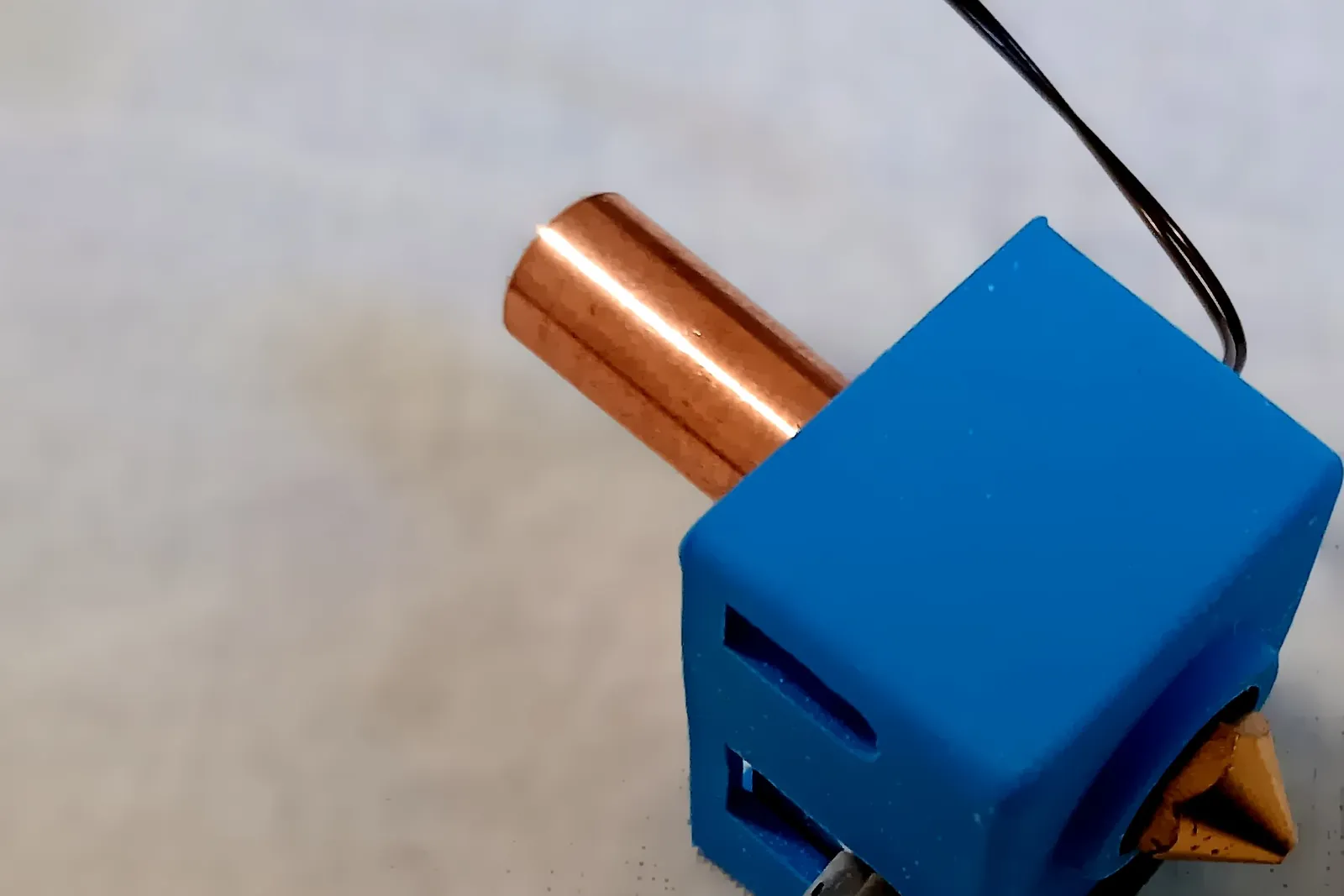
Nozzle material, hotend temperature, chamber heat and drying decide which of these materials a printer can run.
Every carbon or glass filled grade needs a hardened nozzle. Bambu calls it mandatory for PPA-CF and rules out its stainless steel nozzle for PPS-CF. Unfilled PCTG, PP, PVB and the PLA variants run on brass.
Check the hotend's maximum temperature next. PAHT-CF tops out at 290 °C and PPA-CF at 310 °C. PPS-CF wants up to 340 °C, and PEKK and PEEK want 370-410 °C.
Then the chamber. A passive enclosure warmed by the bed suits the 45-60 °C that PAHT-CF asks for, the same kind of warm still air that ASA needs. PPS-CF's 60-90 °C and PEEK's 70-140 °C call for an actively heated chamber. Bambu notes that the upper end of its chamber range improves Z strength, which matters when the Z figure is a quarter of the XY one.
Drying is easy to overlook. PPA-CF and PPS-CF dry at 100-140 °C, far hotter than the 50 °C that PVB needs, and Bambu notes that its cardboard spool tolerates 145 °C and that drying must stay under 160 °C to protect it. An oven or a printer bed is the usual tool.
Which one do you actually need
Start from the temperature and load the part has to survive, then take the least demanding material that clears it.
Tougher than PETG, same printer
Pick PCTG: it uses PETG settings without an enclosure and carries a higher impact rating. For a part that only has to look good, silk or matte PLA will do, and a tough PLA such as PolyMax handles knocks.
Chemical resistance or a light part
Polypropylene works if you have the PP sheet and the patience for warping. PPS-CF resists solvents far better, but it needs a 340 °C hotend and a heated chamber.
A part with no visible layers
Print it in PVB and smooth it with IPA, keeping the spool dry and the room ventilated.
A low friction bushing
Try POM only if you accept small parts and a lot of failed prints. A nylon or a machined acetal part is the easier route.
Hot environments up to about 100 °C
ASA, polycarbonate or ABS from the main filament types already handle this, and they are cheaper and easier than anything in the high temperature class.
Under the bonnet, near a motor, or 150 °C and up
A carbon fibre nylon is the first step: PAHT-CF or a PA12-CF in damp air, PPA-CF when you need more heat and stiffness. PPS-CF covers fuel, solvents and flame on a printer that can run it. PEEK, PEKK and ULTEM are worth paying a bureau for only when the part needs certification, sterilisation, or an aerospace flame and smoke rating.
Frequently asked questions
What is the best high temperature 3D printing filament?
For a desktop printer with a hardened nozzle and an enclosure, carbon fibre PPA or PPS. Bambu Lab rates its PPA-CF at an HDT of 227 °C and its PPS-CF at 264 °C at 0.45 MPa. PEEK, PEKK and ULTEM PEI resist heat for longer and carry flame ratings, but they need 370-410 °C nozzles, hot beds and heated chambers that few printers have.
Is PCTG better than PETG?
PCTG is tougher and prints with the same settings: Spectrum's PCTG runs at 250-270 °C with no enclosure and lists 220% elongation at break. It is not more heat resistant, with an HDT of 76 °C at 0.45 MPa against 69-78 °C for Polymaker's PETG grades.
Can I print PEEK or PEI on a normal 3D printer?
Usually not. 3DXTech's PEEK needs 375-410 °C at the nozzle, a 130-145 °C bed and a 70-140 °C chamber, and Kimya's PEKK-A needs 370-380 °C with a 60-80 °C chamber. Stratasys sells ULTEM 9085 and 1010 for its own F900 and Fortus printers, so most people order these parts from a print service.
Do engineering filaments need a hardened nozzle?
The carbon and glass fibre grades do. Bambu Lab makes a hardened steel nozzle mandatory for PPA-CF, and fibre filled nylons wear brass nozzles. Unfilled PCTG, polypropylene, PVB and the PLA variants print through an ordinary brass nozzle.
Which filament can be smoothed with isopropyl alcohol?
PVB, sold by Polymaker as PolySmooth. You mist a thin coat of IPA on the print, let it dry for 15-20 minutes and repeat until the layer lines disappear, in a well ventilated room. PVB prints at 190-220 °C like PLA but must be kept dry.
Why is POM (acetal) so hard to 3D print?
POM barely sticks to build surfaces and shrinks a lot as it crystallises, so parts warp off the bed. One Prusa user got it to print at 230 °C on a 120 °C bed of scuffed G10 with a 58 °C chamber, fans off and a large brim, and kept parts to about 120 mm. Above 240 °C it can release formaldehyde.
Sources
- Prusa Knowledge Base: Polypropylene (PP)
- Spectrum Filaments: PCTG Premium technical data sheet
- Polymaker Wiki: Technical data at a glance
- Polymaker Wiki: PolySmooth (PVB)
- Bambu Lab: PPA-CF technical data sheet
- Bambu Lab: PPS-CF technical data sheet
- Bambu Lab: PAHT-CF technical data sheet
- Bambu Lab Store: PPA-CF
- Bambu Lab Store: PPS-CF
- Bambu Lab Wiki: PPA/PPS-CF printing guide
- Stratasys: ULTEM 9085 resin material data sheet
- Stratasys: ULTEM 1010 resin material data sheet
- MatterHackers: 3DXTech ThermaX PEEK filament
- Kimya: PEKK-A 3D filament technical data sheet
- Prusa Forum: How to print POM (acetal, Delrin) on a Core One
- Wikipedia: Polyether ether ketone
- Wikipedia: Polyaryletherketone
- Wikipedia: Polyetherimide
- Wikipedia: Polyphenylene sulfide
- Wikipedia: Polyoxymethylene
- Wikipedia: Polypropylene
- Wikipedia: Polyvinyl butyral