- Filament printers release two things: ultrafine particles, about 70% of them under 50 nm in a UL study, and VOCs. HEPA filters catch the particles; vapours such as styrene need activated carbon or venting outdoors.
- Particle emission rates in chamber studies run from about 10⁸ to 10¹¹ per minute. One printer type gave about 2.0 × 10¹⁰ per minute with PLA and 1.9 × 10¹¹ with ABS, and ASA reached 1.7 × 10¹¹ in a 2019 test of eight filaments.
- The largest single vapours were caprolactam from nylon (about 2-180 µg/min), styrene from ABS and HIPS (about 10-110 µg/min) and lactide from PLA (about 4-5 µg/min). IARC classifies styrene as probably carcinogenic, Group 2A.
- Nozzle temperature matters most among the settings a user controls: printing the same ABS from 220 °C to 270 °C raised particle emission exponentially, and a higher fixed temperature raised it at least tenfold for seven materials.
- An enclosure with a HEPA filter removed 99.95% of nanoparticles in one study, and a ventilated enclosure cut particles by over 99% but total organics by only about 70%. A cover without a filter halved particles and left VOC rates unchanged.
- Home PM2.5 sensors count particles from 0.3 µm, well above freshly emitted printer particles, and metal oxide TVOC sensors cannot tell styrene from cleaning sprays, so they are best used to compare readings before and after a change.
3D printer fumes are a mild but real indoor air problem, and how mild depends mostly on the filament and the nozzle temperature. Every chamber study of desktop filament printers has found two kinds of emission: ultrafine particles, smaller than 100 nm, and volatile organic compounds (VOCs) such as styrene from ABS. PLA printed at its usual temperature sits at the low end of both. ABS, ASA and nylon sit higher; in the chamber studies below ABS gave off several times to ten times as many particles as PLA. None of the peer-reviewed work cited here measured a health effect in hobby users. The researchers still advise keeping exposure low: put the printer where the air is changed, keep the nozzle at the low end of the filament's range, and for ABS, ASA or nylon, use an enclosure that is vented outside or filtered with both a HEPA filter and activated carbon.
The figures here come from published chamber and field studies and from guidance by NIOSH, the US occupational health institute, and UL's Chemical Insights Research Institute, read in October 2026. Nanopack has no connection with any printer, filament or filter maker. For the filaments themselves, see the filament types guide and PLA vs PETG vs ABS; for ASA's own fume figures, the ASA settings page.
Particles and vapours: two separate problems
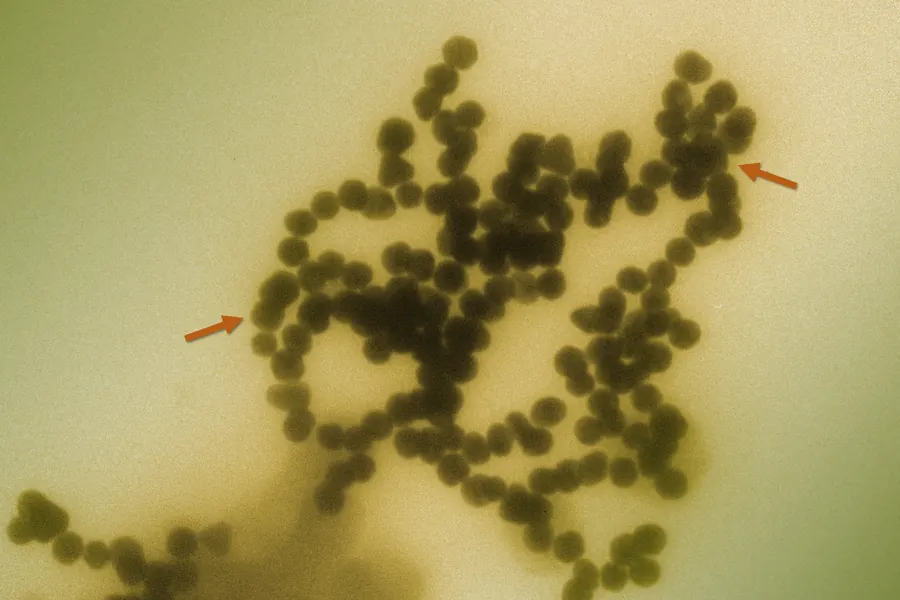
A hot nozzle releases a gas and an aerosol at the same time, and the two need different remedies. The vapours are VOCs: the monomer the plastic was made from, its breakdown products, and traces of additives. The particles form from some of those vapours. A 2018 aerosol modelling study by Zhang and colleagues at Georgia Tech and UL found that the measured particle sizes were best explained by semi-volatile compounds from the heated filament condensing into new particles in a small volume near the nozzle, which then grew by further condensation and by sticking together.
Most of those particles are tiny when they form. In a UL and Georgia Tech chamber study presented at Indoor Air 2016, about 70% of the particles counted were smaller than 50 nm. They started at 40-80 nm and grew to 100-250 nm over a long print as they collided with older particles and took up vapour. Gu and colleagues at Fraunhofer WKI found that the particles consist mainly of semi-volatile organic compounds from plasticisers, flame retardants and antioxidants. Heated in the lab, they began to evaporate at 150 °C, and at 300 °C only a quarter of them were left.
Each needs its own filter. A HEPA filter is rated by the US EPA to catch at least 99.97% of particles at 0.3 µm, its worst case, and smaller particles are trapped with even higher efficiency. The EPA's guide to home air cleaners says most filters are built for either particles or gases, and that removing gases needs activated carbon or another sorbent, ideally a thick bed of it. Styrene is a gas, so a HEPA stage alone is not designed to stop it, and a carbon stage is not rated for particles.
Emission rates by filament
The figures below were measured in emission test chambers, closed boxes flushed with clean air, so everything counted came from the printer. Each row names its study: the numbers depend on printer, filament brand and nozzle temperature, and do not compare directly across studies.
| Filament | Measurement | Figure | Study |
|---|---|---|---|
| PLA | Ultrafine particles | About 2.0 × 10¹⁰ particles/min | Stephens et al. 2013, one printer type in an office |
| PLA | Lactide | About 4-5 µg/min | Azimi et al. 2016, five printers |
| PLA | Particles per gram printed | 1.6 × 10⁹ average (0.004-22.5 × 10⁹) | Davis et al. 2016 (UL, Georgia Tech) |
| ABS | Ultrafine particles | About 1.9 × 10¹¹ particles/min | Stephens et al. 2013, same printer type |
| ABS | Particles, 5.6-560 nm | (4.7 ± 1.1) × 10¹⁰ particles/min | Gu et al. 2019, eight filaments |
| ABS | Particles per gram printed | 62.1 × 10⁹ average; 6.3 × 10⁹ without one high emitting brand | Davis et al. 2016 |
| ABS, HIPS | Styrene | About 10-110 µg/min | Azimi et al. 2016 |
| ABS based (ULTRAT) | Total VOC | 40.5 µg/min, highest of eight | Gu et al. 2019 |
| ASA | Particles, 5.6-560 nm | 1.7 × 10¹¹ particles/min, highest of eight | Gu et al. 2019 |
| PETG based (GLASS) | Particles and total VOC | 2.0 × 10⁹ particles/min; 0.2 µg/min TVOC, both lowest of eight | Gu et al. 2019 |
| Nylon, imitation wood and brick | Caprolactam | About 2-180 µg/min | Azimi et al. 2016 |
| Nylon | Total VOC | 1660 µg/h, highest tested | Davis et al. 2019 |
| PVA | Total VOC | 147 µg/h, lowest tested | Davis et al. 2019 |
Across five printers and up to nine filaments, Azimi and colleagues found median particle emission rates spanning about 10⁸ to 10¹¹ per minute, a thousandfold range driven mainly by the filament and only partly by bed temperature. A 2025 review in Toxics by Gao and colleagues pooled the chamber data for ABS and PLA and found styrene rates from 0.29 to 113.10 µg/min, which agrees with Azimi's range.
For scale, NIOSH researchers (Stefaniak and colleagues, 2017) compared a desktop 3D printer with two monochrome laser printers in the same 0.5 m³ chamber. The 3D printer released 49-3552 µg of total VOC per hour depending on filament, colour and one malfunction. The laser printers released 5782-7735 µg/h. The 3D printer produced 14 VOCs that the laser printers did not.
What styrene, caprolactam and lactide are
The three compounds emitted in the largest amounts in Azimi's study are each tied to one plastic.
Styrene is the "S" in ABS, and HIPS, ASA and PC-ABS contain it too. The International Agency for Research on Cancer classified it as probably carcinogenic to humans, Group 2A, in Volume 121 of its Monographs, published in 2019. The classification is about whether styrene can cause cancer, and it gives no verdict on the dose from a hobby printer. In UL's tests styrene made up 39-49% of total VOC from different ABS brands, and in Wojtyła and colleagues' 2017 heating experiments more than 30%. Stefaniak's group found that freshly printed ABS objects kept giving off styrene after the print ended.
Caprolactam is the monomer of nylon 6, so nylon filaments release it when heated, and in Azimi's study so did some imitation wood and brick filaments. UL's 2016 paper pointed to California's chronic reference exposure level for caprolactam, 7 µg/m³ over 8 hours, and predicted that concentrations during a nylon print would be at least 14 times higher.
Lactide, the third, is the ring-shaped double ester of lactic acid that PLA is made from. It was the top VOC from PLA in UL's tests. The second was methyl methacrylate, an irritant, which some PLA brands released and others did not; in Wojtyła's experiments it made up 44% of the VOCs from PLA. Whether PLA smells pleasant to someone tells them nothing about its particle count. UL's safety handout notes that VOCs can be odorants as well as irritants or carcinogens, and that neither VOCs nor ultrafine particles can be seen.
Nozzle temperature, brand and colour
Nozzle temperature is the setting with the largest effect that a user controls. UL printed the same ABS filament at nozzle temperatures from 220 °C to 270 °C. Particle emission rose exponentially with temperature, while total VOC and styrene rose in a straight line. Kwon and colleagues (2017) printed seven materials at the maker's recommended temperature and again at a higher fixed temperature, and every one emitted at least ten times more nanoparticles at the higher setting. In the Georgia Tech aerosol model, the rate at which vapour came off the filament tracked extruder temperature, and it accounted for much of the difference between materials and brands.
This partly explains why ABS outranks PLA. In Stephens's 2013 measurements the same printer type emitted about ten times more particles with ABS, which it ran hotter. Zhang and colleagues found in 2019 that ABS extruded at a higher temperature emitted vastly more particles than PLA, and that their composition differed from the bulk filament, pointing to trace additives.
The brand of filament matters almost as much. In UL's study, total particle emissions varied by a factor of 20 between filament sources, and one ABS brand emitted about ten times more than the others. Colour made a smaller difference: for one ABS brand in five colours, the particle yield ranged only from 9.1 to 11.3 × 10¹⁰ per gram. NIOSH's guide reads the chamber work the same way: extruder temperature is the main factor, and filament brand has a substantial effect, likely through trace components.
What is known about health effects
The direct evidence is thin, and the researchers say so. NIOSH's 2023 guide to safe 3D printing lists a case of work-related asthma in a worker using ABS, and a survey in which 27 of 46 workers who maintained and used printers running PLA, ABS and nylon reported respiratory symptoms. In an animal study it cites, mean arterial pressure in the exposed group was 28% higher than in controls. NIOSH adds that it is unclear whether such effects come from the particles, the vapours or both.
Laboratory toxicity tests point the same way without settling the question. Zhang and colleagues (2019) exposed cell cultures and mice to particles from PLA and ABS. Both caused toxic responses, and PLA particles caused more per unit of mass. ABS was still judged the bigger concern overall because printers emitted so many more particles with it. The authors concluded that 3D printer particles are not benign and exposure should be minimised.
Predicted room concentrations depend heavily on the room. In a field study NIOSH cites, particle levels in a conference room with several printers running were much lower than levels measured from one printer in a test chamber, because the room was larger and its ventilation supplied 12-14 air changes per hour. UL's 2024 study of school classrooms found PM2.5 well below the US EPA 24-hour standard of 35 µg/m³ while printers ran, but it also found formaldehyde above California's recommended indoor level in two rooms, from several possible sources, and more than 200 VOCs in total. Many of those came from cleaning products and air fresheners rather than the printers.
Enclosures, HEPA and carbon filters
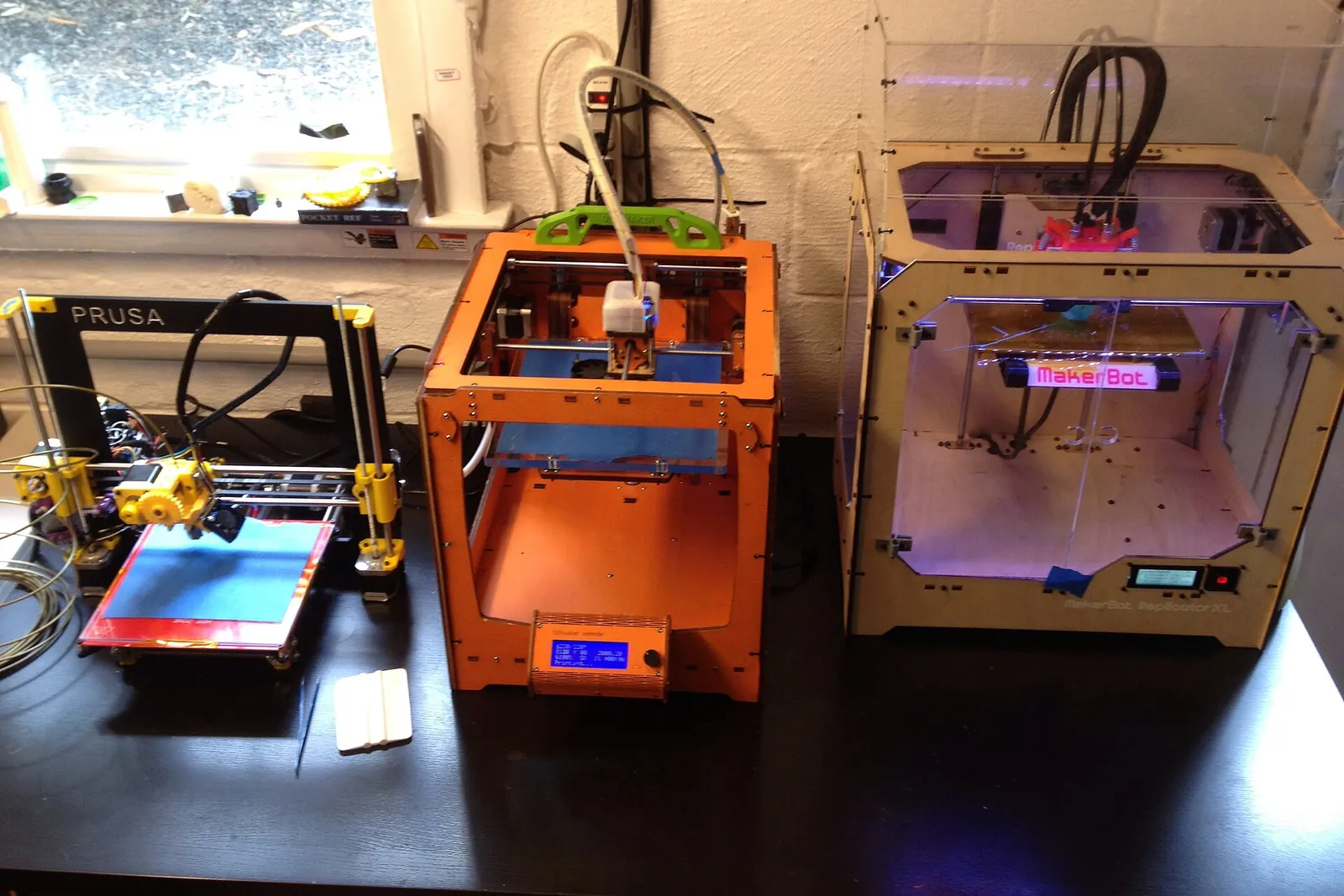
Measured reductions are large for particles and smaller, or less consistent, for vapours. A plain cover without a filter did the least.
| Setup | Particles | VOCs | Source |
|---|---|---|---|
| Printer maker's cover, no filter | Total particle emissions halved | TVOC emission rates not changed by the cover | Yi et al. 2016; Stefaniak et al. 2017 (NIOSH) |
| Filter cover or room air purifier | 74-93% of ultrafine particles removed, filter cover best | Varying removal of styrene and ethylbenzene; new filters gave off VOCs until conditioned for 4-5 days | Gu et al. 2019, 30 m³ chamber |
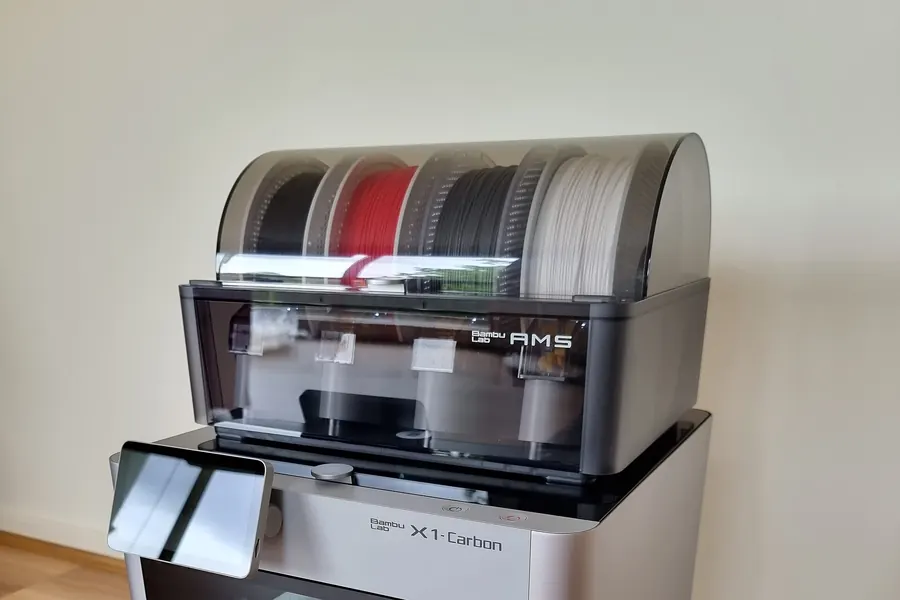
| Enclosure with HEPA filter | 99.95% of nanoparticles, best of eight setups | Not reported | Kwon et al. 2017 |
| Filtered enclosing hood over the printer | 97-99% reduction | Not reported | Hall et al. 2019 (UK HSE), cited by NIOSH |
| Retrofitted enclosure; then exhausted outdoors through HEPA | 97%; 99% with exhaust | Not reported | Viitanen et al. 2021, cited by NIOSH |
| Ventilated enclosure for a bank of printers | Over 99% in the print room | Total organics down by almost 70% | NIOSH 2017 evaluation, cited in NIOSH 2023 guide |
| Integrated filtration systems tested by UL | Maximum particle concentration down 95% or more | Not stated as a single figure | UL Chemical Insights |
HEPA media stops ultrafine particles well, so a sealed box with a good HEPA stage removes most of them. Carbon has to adsorb each gas, and the EPA says it works best when there is a lot of it, with every filter needing replacement once loaded. The EPA notes that there is no widely used performance rating for filters meant to remove gases, unlike the clean air delivery rate for particles, so a carbon pad's claims are hard to check.
Venting to the outdoors handles both problems, because the air leaves the room instead of passing through a filter and coming back. NIOSH lists ducting enclosed printers to the outside and keeping the printing room at slightly lower pressure than the rooms around it. For filtered local exhaust it suggests adding gas and vapour filters if VOCs are a concern. The UK HSE work it cites also recommends waiting about 20 minutes after a print finishes before opening the enclosure, so the filter or fan can clear the air inside.
Room ventilation matters even with an enclosure. A NIOSH-cited assessment of three university makerspaces recommended at least six air changes per hour, or a portable HEPA air cleaner, during printing. A separate study concluded that three air changes per hour was not enough for regular, long use of desktop printers.
What a PM2.5 or TVOC sensor can measure
Consumer air monitors are useful for seeing that something changed, and poor at saying how much of the printer's output you are breathing.
Most cheap particle sensors count light scattered by particles passing a laser. The data sheet for the Plantower PMS5003, a common module in home monitors, gives a minimum particle diameter of 0.3 µm, with 50% counting efficiency at 0.3 µm and 98% at 0.5 µm and above. Freshly emitted printer particles of 40-80 nm are far below that. Such a sensor sees printer emissions only after particles have grown, and it reports mass as PM2.5. In UL's 2016 chamber data the particle count was dominated by particles under 50 nm, while the mass came mostly from particles of 100-300 nm. UL's classroom report makes the same point: monitoring only PM2.5 may miss the ultrafine range and underestimate the effect of printing. In that study PLA raised particle numbers more than ABS did, while ABS raised PM2.5 more, so a PM2.5 reading alone would have suggested the opposite ranking.
TVOC readings from metal oxide sensors have a different weakness. Sensirion describes its SGP40 as broadband and unselective: it cannot tell one VOC from another and cannot measure absolute concentration. Its VOC Index compares the air with the average of the previous 24 hours and adapts to a long event within a few hours, so a long print gradually reads as background. The sensor responds just as readily to ethanol, cleaning sprays and cooking. A rising TVOC number during an ABS print shows that something is being released; it cannot show whether that is styrene or how much.
The studies used condensation particle counters, which see particles down to a few nanometres, and identified VOCs by gas chromatography and mass spectrometry. NIOSH notes that no single direct-reading instrument covers every particle size, and suggests a person trained in industrial hygiene for real measurements. A home sensor is most useful for before and after comparisons: whether a fan, a closed door or a filtered enclosure changes the reading in the same room.
Bedroom, vented enclosure, duct or outdoors
Davis and colleagues (2019) modelled exposure in a bedroom and a classroom from their chamber data, and some compounds of concern exceeded recommended indoor levels. That argues against running a printer next to the bed overnight with the door shut. UL's advice to keep people away from a running printer and close the door of its room is hard to follow in a bedroom. If that is the only space, its other advice still applies: PLA where possible, the lowest workable temperature, an open window or an exhaust fan, and a camera instead of sitting by the machine. UL says particle emission rates peak over about 20 minutes, and its field data show that peak right after a print starts.
For ABS, ASA, HIPS or nylon indoors, the setup with the strongest evidence is an enclosure with an exhaust duct to the outside. A sealed enclosure that recirculates air through HEPA and activated carbon is the next option; it catches particles reliably and removes part of the vapour, depending on the amount of carbon and how fresh it is. The studies say nothing about ducts in winter or rain. NIOSH's one note on layout is to place exhaust fans so that as little duct as possible runs at positive pressure inside the room, which keeps a leaky joint from pushing fumes back out.
Printing outdoors or in a garage trades exposure for print quality. None of the studies cited here tested a printer outdoors, but the NIOSH field data show how much a larger, well ventilated space dilutes emissions. Cold air and draughts are what make ABS and ASA warp, which is covered in the ASA settings guide.
Masks are a last resort, and the guidance is split. UL states that basic dust masks do not stop VOCs or ultrafine particles. NIOSH's infographic for filament printing lists an N95 respirator for particles, which does nothing for vapours. Both put ventilation, temperature and material choice ahead of anything worn on the face.
Who should be more careful
UL's research institute names children, older adults and people with existing respiratory conditions such as asthma as the groups it is most concerned about, and its classroom report singles out young children. The human reports NIOSH cites, the asthma case linked to ABS printing and the 27 of 46 printer workers with respiratory symptoms, all come from people who spent long hours near printers at work. For anyone in those groups, the same measures apply with less slack: PLA over ABS where the part allows it, the lowest nozzle temperature that prints well, and a printer kept out of shared living space.
Nanoparticle filled filaments add a further question, since NIOSH found that printing with them releases particles that contain the filler. The carbon fiber and graphene filament page covers those results. Resin printers are a separate technology with their own VOCs and skin sensitisers, and are not covered here.
Frequently asked questions
Are 3D printer fumes toxic?
Desktop filament printers emit ultrafine particles and volatile organic compounds, some of them irritants or suspected carcinogens such as styrene from ABS. Researchers at NIOSH and UL advise keeping exposure low through ventilation, low nozzle temperatures and low emitting filaments. Health effects in hobby users have not been measured directly; NIOSH reports respiratory symptoms in workers who spent long hours near printers.
Are PLA fumes safe?
PLA is among the lowest emitting filaments in chamber studies. One printer type released about 2.0 × 10¹⁰ particles per minute with PLA against 1.9 × 10¹¹ with ABS, and its main vapour, lactide, came off at about 4-5 µg/min. It is not emission free: a 2019 study found PLA particles more toxic per unit mass than ABS particles in lab tests, though ABS printers emitted far more of them.
Is it safe to 3D print in a bedroom?
A 2019 UL and Georgia Tech study modelled exposure in a bedroom from chamber data and found some compounds of concern above recommended indoor levels. If a bedroom is the only space, UL's advice points to PLA at the lowest workable temperature, an open window or exhaust fan, and not sitting next to the printer or sleeping beside it during long prints. ABS, ASA and nylon need a vented or filtered enclosure.
Do I need a HEPA filter or a carbon filter for my 3D printer?
Both, for ABS, ASA or nylon. HEPA filters remove ultrafine particles; an enclosure with a HEPA filter removed 99.95% of nanoparticles in a 2017 study. Gases such as styrene pass through HEPA and need activated carbon, which the US EPA says works best in a thick bed. Venting the enclosure outdoors handles both.
Can an air quality monitor detect 3D printer fumes?
Only partly. Common optical PM2.5 sensors such as the Plantower PMS5003 detect particles from 0.3 µm, while printer particles start at 40-80 nm. Metal oxide TVOC sensors react to many gases at once and report a value relative to the last 24 hours, so they cannot measure styrene. They are useful for before and after comparisons in the same room.
Does a lower nozzle temperature reduce 3D printer fumes?
Yes. When UL printed one ABS filament at 220-270 °C, particle emission rose exponentially and styrene rose linearly with temperature. Kwon and colleagues found at least ten times more nanoparticles for all seven materials they tested at a higher fixed temperature than at the maker's recommended one. NIOSH and UL both advise the lowest temperature that prints well.
Sources
- Azimi P. et al. (2016), Emissions of ultrafine particles and volatile organic compounds from commercially available desktop three-dimensional printers with multiple filaments, Environmental Science & Technology 50:1260-1268
- Gu J. et al. (2019), Characterization of particulate and gaseous pollutants emitted during operation of a desktop 3D printer, Environment International 123:476-485
- Stephens B. et al. (2013), Ultrafine particle emissions from desktop 3D printers, Atmospheric Environment 79:334-339
- Davis A. et al. (2016), Fine particulate and chemical emissions from consumer 3D printers, Indoor Air 2016 proceedings (UL and Georgia Tech)
- Davis A. et al. (2019), Characterization of volatile organic compound emissions from consumer level material extrusion 3D printers, Building and Environment 160:106209
- Zhang Q. et al. (2018), Investigating particle emissions and aerosol dynamics from a consumer fused deposition modeling 3D printer with a lognormal moment aerosol model, Aerosol Science and Technology 52:1099-1111
- Zhang Q. et al. (2019), Chemical composition and toxicity of particles emitted from a consumer-level 3D printer using various materials, Environmental Science & Technology 53:12054-12061
- Stefaniak A. B. et al. (2017), Characterization of chemical contaminants generated by a desktop fused deposition modeling 3-dimensional printer, Journal of Occupational and Environmental Hygiene 14 (NIOSH)
- Yi J. et al. (2016), Emission of particulate matter from a desktop three-dimensional (3D) printer, Journal of Toxicology and Environmental Health A 79 (NIOSH)
- Wojtyła S., Klama P., Baran T. (2017), Is 3D printing safe? Analysis of the thermal treatment of thermoplastics: ABS, PLA, PET, and nylon, Journal of Occupational and Environmental Hygiene 14:D80-D85
- Kwon O. et al. (2017), Characterization and control of nanoparticle emission during 3D printing, Environmental Science & Technology 51:10357-10368
- Gu J. et al. (2019), Emission control of desktop 3D printing: the effects of a filter cover and an air purifier, Environmental Science & Technology Letters 6:499-503
- Gao Y. et al. (2025), Emission characteristics of volatile organic compounds from material extrusion printers using ABS and PLA filaments, Toxics 13:276
- NIOSH (2023), Approaches to Safe 3D Printing: A guide for makerspace users, schools, libraries, and small businesses, DHHS (NIOSH) Publication 2024-103
- NIOSH: How to reduce exposures when 3D printing with plastic filament (infographic)
- UL Research Institutes, Chemical Insights: 3D printing emissions and its impact on human health
- UL Chemical Insights (2024), Technical Report R360: The impact of 3D printing on indoor air quality in educational settings
- UL Chemical Insights: 3D printer safety, 10 ways to promote healthy indoor air quality
- US EPA: What is a HEPA filter?
- US EPA: Guide to air cleaners in the home
- Plantower PMS5003 series data manual v1.0
- Sensirion (2020), SGP40 VOC Index for Experts v1.1
- IARC Monographs Volume 121 (2019): Styrene, styrene-7,8-oxide, and quinoline
- CAREX Canada: Styrene profile (IARC Group 2A)