- Filament has to be dried below the temperature at which it softens, because heating a spool past its glass transition fuses the windings and can distort the spool itself.
- Bambu Lab's published forced-air oven settings run from 50 °C for 8 hours for PLA up to 100-140 °C for 8-12 hours for PPA-CF and PPS-CF, with PETG at 60-65 °C, ABS and ASA at 75-85 °C and nylon grades at 75-85 °C for 8-12 hours.
- Polymaker's PolyMide CoPA nylon falls from 78.0 MPa tensile strength and 2703 MPa stiffness when dry to 34.3 MPa and 724 MPa after soaking to 6.16 % moisture, while its notched impact strength rises from 6.9 to 27.7 kJ/m² because water plasticises the polymer.
- Prusament measured moisture uptake over seven days at 22 % relative humidity at 0.19 % by weight for PLA, 0.10 % for PETG and 0.17 % for ASA.
- Bambu Lab puts ordinary indoor air at 45-65 % relative humidity and says freshly dried filament reabsorbs enough moisture to affect print quality within 2 to 12 hours at 55 % RH, which is why sealed storage with desiccant matters more than how often you dry.
- Water in the melt cuts ester and amide bonds by hydrolysis, and that loss of molecular weight is permanent, so drying a spool restores printability but cannot recover the strength of parts already printed wet.
Filament picks up water from the air, and the water turns to steam inside the hot end. That is the whole problem. The steam blows bubbles through the melt, and the printer lays down a bead that hisses, strings, pits and bonds badly to the layer under it. Drying reverses the pickup. The rule that governs every drying schedule is that the filament has to be held below the temperature at which it softens, for long enough that water diffuses out of a 1.75 mm strand wound tight on a spool, which takes hours rather than minutes.
How much this matters depends on the polymer. Nylon, polycarbonate, PVA and TPU absorb enough water to change how the finished part behaves; PLA and PETG absorb little enough that a sealed bag and a sachet of silica gel usually cover it. The numbers on this page come from manufacturer drying tables and technical data sheets, mainly Bambu Lab, Polymaker and Prusa, which publish different figures for the same materials because they are drying their own spools in their own equipment. Where they disagree, both are given, and all of them sit in one table under drying temperatures and times by material. For the wider comparison of what each filament is for, see the chart of 3D printing filament types.
Which filaments absorb water, and how much
Every common filament is hygroscopic to some degree. What separates them is the chemistry of the backbone. Polyamides carry an amide group on every repeat unit, and the nitrogen and oxygen in it hydrogen bond with water, which is why nylon is the worst offender in any workshop. Polyesters such as PLA and PETG have ester groups, which are less polar and take up less. Styrene polymers like ABS and ASA have almost nothing for water to grip, so their uptake is modest, though manufacturers still recommend drying them.
Prusament publishes measured uptake for its own spools after seven days at 22 % relative humidity: 0.19 % by weight for PLA, 0.10 % for PETG and 0.17 % for ASA. Those are small numbers, and they are measured at a humidity most homes never see. Bambu Lab puts ordinary indoor air at 45 % to 65 % RH, higher in humid weather, and says that even in a 20 % RH dry environment filaments stay dry for something between two and seven days depending on the material.
Those percentages are worth converting, because they set what any home measurement can resolve. On a 1 kg spool, 0.19 % is 1.9 g of water and 0.10 % is 1.0 g. A nylon spool saturated the way Polymaker conditions its test bars, at 6.16 %, would hold 62 g. That range explains why weighing works well for polyamide and barely at all for PETG on a kitchen scale.
A useful shortcut is to read how a manufacturer classifies the material rather than chase a percentage. Bambu Lab's drying table marks each filament as either recommended or required to dry before use. Required covers PLA Wood, every TPU grade, PC, PVA, the PA and PET carbon and glass filled grades, PPA-CF and PPS-CF. Plain PLA, PETG, ABS and ASA sit in the recommended column, which in practice means dry it if the spool has been open a while or the print has to look good.
What a damp spool looks like on the printer
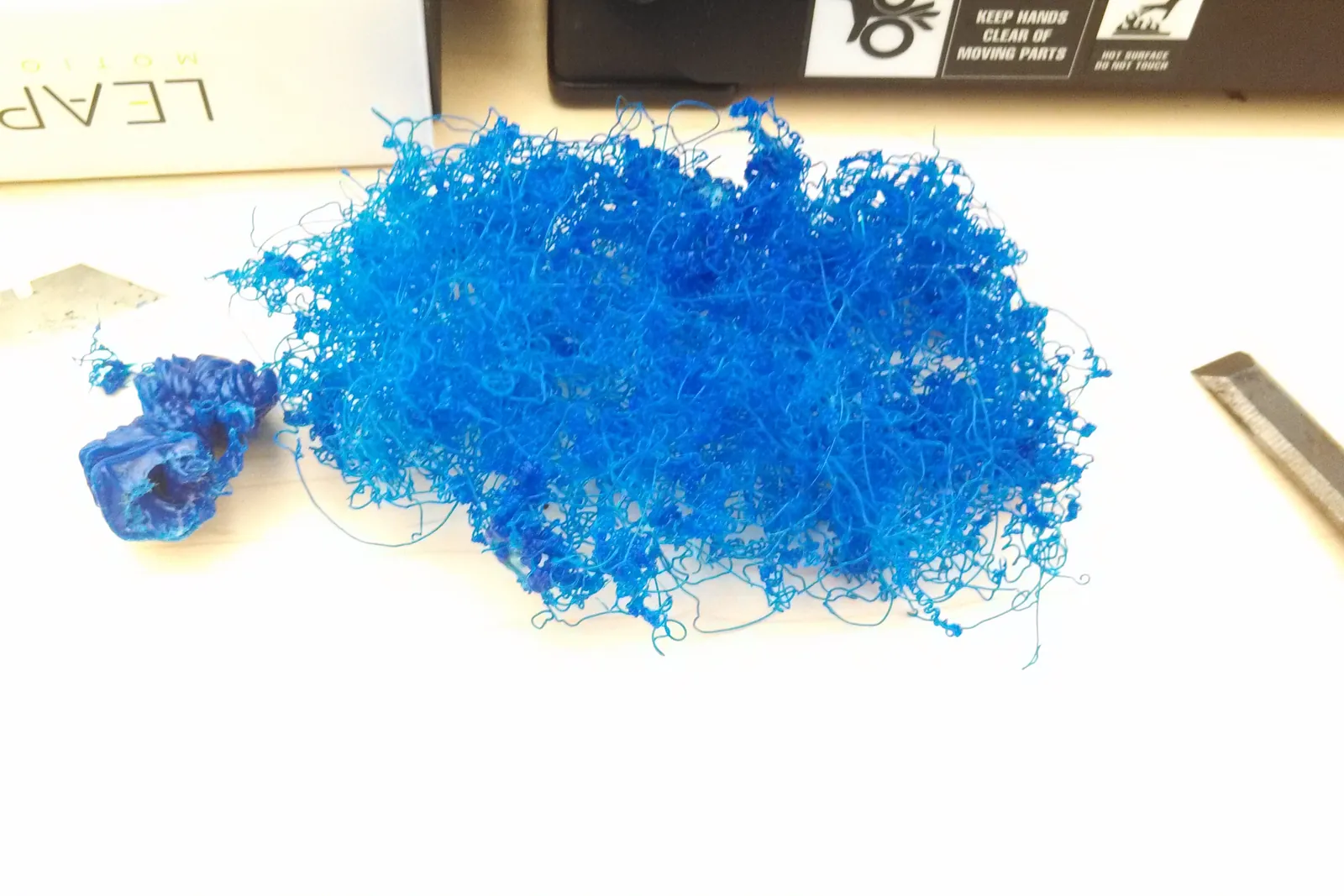
The symptoms all come from the same event, which is water flashing to steam somewhere between the melt zone and the nozzle tip. Bambu Lab describes damp filament as extruding erratically and forming bubbles, which shows up as stringing, oozing, holes, rough surfaces and reduced strength.
In front of the machine it usually goes like this. There is an audible pop or hiss at the nozzle, sometimes visible steam. The extruded bead comes out wider than it should and with a matt, foamy texture instead of a glossy one. Surfaces that were smooth on the last spool are now pitted. Fine detail rounds off. Stringing gets worse across travel moves even after retraction has been tuned, because the bubbles keep pushing plastic out when the extruder has stopped. Layers peel apart under a modest load, since the bubbles leave voids where the weld between layers should be.
Translucent materials give the clearest tell. Bambu Lab's own comparison photograph of moisture affected against dry PETG shows the wet sample cloudy where the dry one is clear, because the bubbles scatter light.
What the water actually does
Two things happen, on different timescales.
The physical one is immediate. Water boils at 100 °C and nozzles run between 190 °C and 300 °C, so any water in the strand becomes steam the moment it reaches the melt zone. The steam expands, blows voids through the bead and disturbs the flow that the slicer assumed was steady.
The chemical one is slower and permanent. Both ester and amide bonds are cut by water at elevated temperature, a reaction called hydrolysis. Each cut turns one long chain into two shorter ones, so the average molecular weight of the polymer falls. Molecular weight is what gives a thermoplastic its strength, because long chains entangle and short ones slide past each other, and a melt that has been hydrolysed is weaker after it has cooled even though it looks like the same plastic. This is why the advice is to dry before printing rather than to print and hope.
How much strength is at stake
Polymaker publishes mechanical properties for its PolyMide CoPA nylon in two states, dry and wet, tested to the same ISO methods on printed bars. The wet specimens were annealed at 80 °C for 6 hours and then immersed in water at 60 °C for 48 hours, reaching an average moisture content of 6.16 %.
| Property | Dry | Wet |
|---|---|---|
| Tensile strength | 78.0 ± 0.7 MPa | 34.3 ± 2.5 MPa |
| Young's modulus | 2703 ± 259 MPa | 724 ± 61 MPa |
| Bending strength | 109.8 ± 1.3 MPa | 22.6 ± 0.5 MPa |
| Bending modulus | 2510 ± 25 MPa | 636 ± 11 MPa |
| Elongation at break | 12.7 ± 2.1 % | 13.2 ± 2.3 % |
| Notched Charpy impact | 6.9 ± 1.4 kJ/m² | 27.7 ± 1.2 kJ/m² |
Tensile strength falls to 44 % of the dry figure and stiffness to 27 %. The interesting row is the last one, where notched impact strength goes the other way and quadruples. Water acts as a plasticiser in nylon: it slips between the chains, lets them move, and a material whose chains can move absorbs an impact instead of cracking. A wet nylon part is softer, weaker and floppier, and harder to snap with a hammer blow. Neither state is the one the designer specified.
One distinction decides how to read that table, and it is easy to lose. Those specimens were printed dry and then soaked. What the wet column measures is a finished part that has taken up water in service, which softens it by plasticisation and which drying the part reverses. Printing from wet filament is the other problem: steam voids in the bead and, where hydrolysis has run in the melt, chains that stay cut. The two overlap in the workshop and behave differently.
Read the figures as an upper bound rather than as what a spool left out over a weekend will do. Immersion in 60 °C water for two days is a conditioning procedure designed to saturate the specimen, and 6.16 % moisture is far more than a spool picks up on a shelf. The direction is what carries over to a real workshop, and the size of the gap is why nylon is the material people notice it on first.
Drying temperatures and times by material
The constraint on every schedule is the softening point. Heat the spool past the glass transition of the polymer and the windings fuse, the spool itself can distort, and the filament comes out oval or welded into a solid block. Bambu Lab is explicit that when you dry a high temperature filament such as ABS or PETG, the temperature will exceed the softening point of PLA and TPU, so those have to come out of the chamber first.
Why the ceiling sits where it does
Glass transition is the temperature at which an amorphous polymer stops behaving like a solid and starts to creep. It is the number every drying schedule is written under. PLA's sits at 60-65 °C, PETG's at 75-81 °C, ASA's near 98-100 °C and ABS's at 101-105 °C, which is why the oven figures for those four materials climb in the same order: 50 °C, 60-65 °C, and 75-85 °C for the pair of styrenics.
The gap between the drying temperature and the glass transition is the safety margin, and it is narrow on purpose, because water leaves faster the warmer the polymer is. Bambu Lab's 50 °C for PLA sits about 10 degrees under the transition. Manufacturers who quote a higher figure for the same material, such as Polymaker's 55 °C, are working with a smaller margin and their own spools. A domestic oven that overshoots by 15 degrees on the way to setting point will cross the line either way, which is the argument for a dryer with a thermostat built for the job.
Semi-crystalline polymers behave differently. Nylon and PC keep their shape well above the glass transition because the crystalline regions hold the part together, which is how 85 °C drying is possible for a polyamide whose amorphous phase softened long before. The limit there is the spool rather than the filament: a polycarbonate or ABS spool will take it, and a low-cost polystyrene one may not.
The table below is Bambu Lab's published drying parameters, which is the most complete public set, with Polymaker's and Prusa's figures for the same materials alongside where they publish them. The three columns disagree because they assume different equipment: a forced air oven moves more air than a heated chamber and gets there sooner.
| Material | Bambu Lab, forced-air oven | Bambu Lab, AMS HT | Other manufacturers |
|---|---|---|---|
| PLA | 50 °C, 8 h | 45 °C, 12 h | Polymaker PolyLite PLA 55 °C, 6 h; Prusa 45 °C, 6 h |
| PLA Silk, PLA Galaxy | 55 °C, 8 h | 45 °C, 12 h | |
| PLA Wood | 55-65 °C, 8 h | 45 °C, 12 h | |
| PLA-CF, PLA-GF | 50-60 °C, 8 h | 45 °C, 12 h | Polymaker PLA-CF 55 °C, 6 h |
| PETG | 60-65 °C, 8 h | 65 °C, 12 h | Polymaker PolyLite PETG 65 °C, 6 h; Prusa 55 °C, 6 h |
| PETG-CF | 60-65 °C, 8 h | 65 °C, 12 h | Polymaker Fiberon PETG-rCF08 65 °C, 3 h |
| ABS | 75-85 °C, 8 h | 80 °C, 8 h | Polymaker PolyLite ABS 70 °C, 6 h |
| ASA | 75-85 °C, 8 h | 80 °C, 8 h | Polymaker ASA 70 °C, 7 h; Prusa 80 °C, 4 h |
| ASA-CF, ABS-GF | 80 °C, 8 h | 80 °C, 8 h | |
| TPU 85A to 95A | 70 °C, 8 h | 75 °C, 18 h | Polymaker TPU95 70 °C, 8 h; Prusa 60 °C, 4-6 h |
| PC | 75-85 °C, 8 h | 80 °C, 8 h | Polymaker PolyLite PC 75 °C, 6 h; Prusa PC Blend 85 °C, 5 h, PC Blend Carbon Fiber 90 °C, 4 h |
| Nylon, PA6-CF/GF, PAHT-CF/GF | 75-85 °C, 8-12 h | 85 °C, 12 h | Polymaker CoPA 100 °C, 8 h; Polymaker Fiberon PA6-CF20 and PA12-CF10 100 °C, 10 h; Prusa PA11-CF 90 °C, 6 h |
| PET-CF | 80 °C, 8-12 h | 80 °C, 12 h | Polymaker Fiberon PET-CF17 100 °C, 10 h |
| PVA | 75-85 °C, 8-12 h | 85 °C, 18 h | Polymaker PolyDissolve S1 80 °C, 12 h |
| PPA-CF, PPS-CF | 100-140 °C, 8-12 h | Not compatible | |
| Support for PA/PET | 75-85 °C, 8-12 h | 80 °C, 12 h | |
| Support for ABS | 80 °C, 4 h | 80 °C, 4 h |
The widest disagreement is on the filled engineering grades. Polymaker's data sheets give 100 °C for 10 hours for its PA6-CF20, PA12-CF10 and PET-CF17, while Bambu Lab stops at 75-85 °C for nylon and 80 °C for PET-CF. Bambu Lab's notes to the same table describe 80-90 °C as within the maximum heat resistance of its spool, so its figures are set by the reel as much as by the polymer. Before running a filament at 100 °C, check what its spool is rated to; the ratings Prusa and UltiMaker publish for theirs are under keeping filament dry.
Two limits are worth knowing before buying hardware. Bambu Lab's AMS 2 Pro tops out at 65 °C, which rules out ABS, ASA, PC, PVA and the nylons, and the company says so in the same table. PPA-CF and PPS-CF need 100 °C to 140 °C, above what any consumer drying box reaches, so a laboratory oven is the only route.
Times are long because diffusion through a wound spool is slow. Bambu Lab's heated bed method runs 12 hours for most materials and asks for the spool to be flipped every 6 hours, since the side facing the bed dries first. Its AMS units rotate the spool 30° every five minutes for the same reason.
What to dry filament in
A dedicated filament dryer is a heated box with a fan and a spool holder, sold by most filament brands, and it is the least troublesome option because the temperature limits are already set for the materials it expects. Its weakness is capacity, usually one or two spools, and a ceiling that may be below what nylon or PC wants.
A domestic oven is where the manufacturers disagree, and the disagreement is worth knowing before following any of them. Bambu Lab is flat about it: do not use a microwave or a kitchen oven, because microwave heating cannot be controlled and kitchen ovens distribute heat so unevenly that the area near the element will damage the spool. Prusa allows it with conditions, warning that home ovens measure temperature poorly, that fluctuations harmless to food will damage filament, and that many will not go low enough for PLA at all. Polymaker permits a household convection oven at a low stable temperature and argues that airflow matters more than heat.
If an oven is the only option, the geometry is published. Bambu Lab's reusable spool is 200 mm across and 67 mm tall, so the cavity needs at least 250 mm of depth and width and 90 mm of height, with the spool kept away from the heating elements.
The printer's own heated bed works as a drying plate. Bambu Lab publishes bed temperatures per material, generally 20 °C to 30 °C above the oven figure because the heat only reaches the spool from one side, and asks for a cover such as the filament packaging box to trap the warm air.
A food dehydrator is the common improvised answer. It is a fan and a low thermostat, which is the right shape for the job, and the trays usually unclip to leave room for a spool. Check the actual temperature with a separate thermometer before trusting the dial.
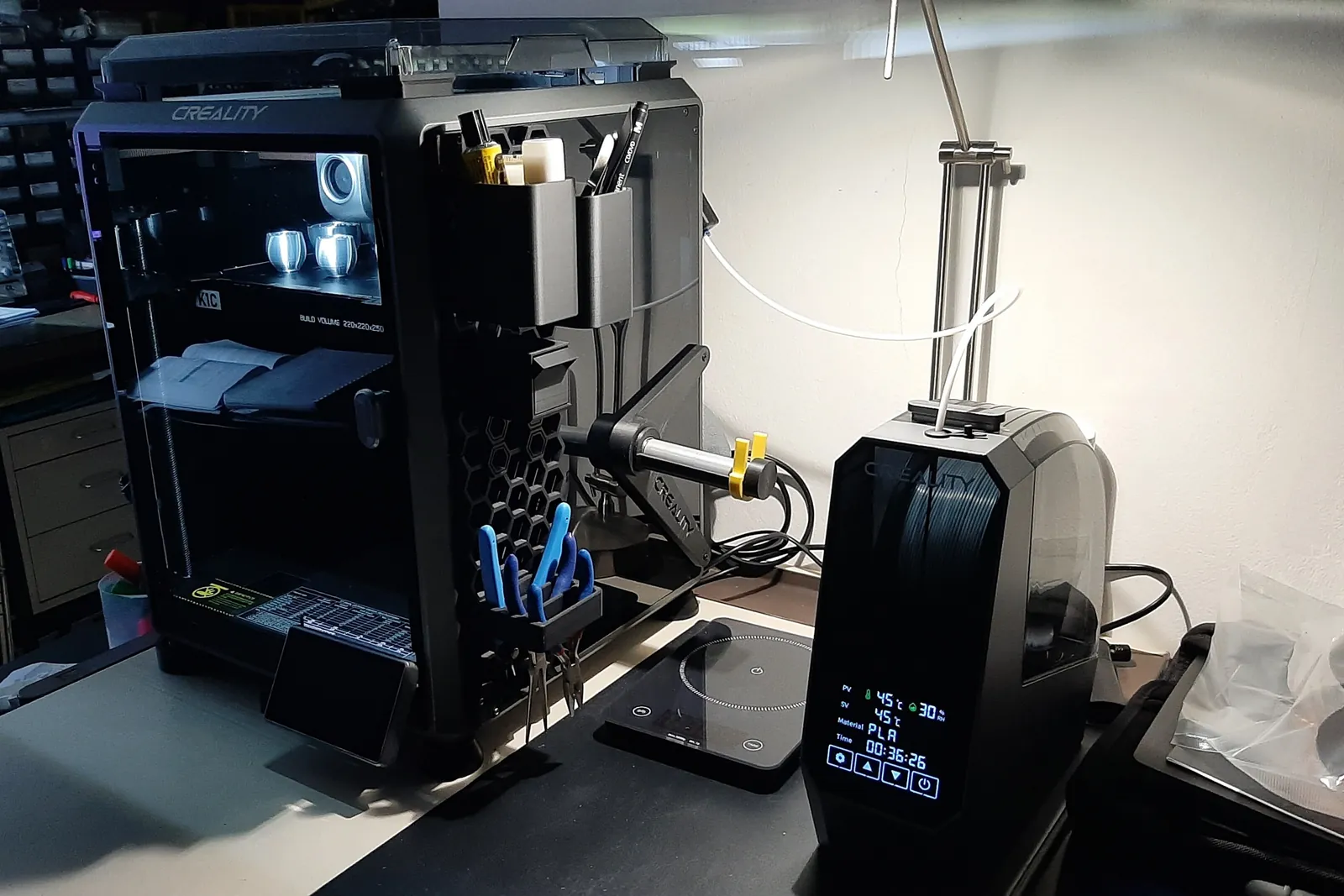
Two things to avoid. A microwave heats the water rather than the air and will do it unevenly enough to ruin the spool. Leaving filament in a car or a greenhouse relies on sunlight to reach a temperature nobody is controlling.
Drying on the printer's own bed
Bambu Lab publishes a separate set of bed temperatures for drying a spool laid flat on the heated bed under a cover. They run higher than the oven figures because the heat arrives from one side only: 60-70 °C for PLA, 75-85 °C for PETG, 90-100 °C for ABS, ASA, PC, PVA and the filled nylons, 80-90 °C for most TPU, and 110-120 °C for PPA-CF and PPS-CF, which the company notes is less effective than a convection oven. The time is 12 hours for nearly everything, and PLA and the ABS support material are to be flipped every 6 and 3 hours respectively.
The cover matters as much as the temperature. Without something over the spool the warm air leaves immediately, and Bambu Lab suggests the filament packaging box or a polycarbonate cover for exactly that reason.
Staying dry during the print
Drying before a print and keeping the spool dry through it are separate problems, and the second one is what decides a long job. A print that runs 30 hours gives the filament 30 hours to reabsorb, which for nylon is enough to undo the drying that preceded it.
This is why Bambu Lab's table carries a second column, desiccant protection during use, alongside the drying requirement. It is marked required for PLA Wood, every TPU grade, PC, PVA, PET-CF and the PA carbon and glass filled grades, and recommended for everything else. The practical form is either a heated chamber that runs while printing or a sealed box with fresh desiccant feeding the printer through a tube.
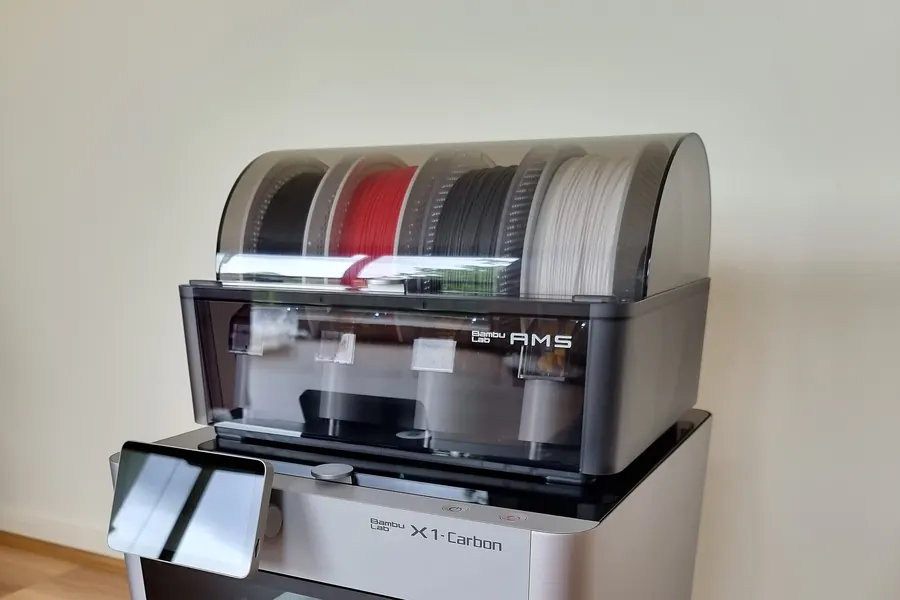
Where the drying hardware sits in the filament path decides its ceiling. Bambu Lab's AMS 2 Pro is limited to filaments that dry at 65 °C or below, which covers PLA, PETG and the support materials and excludes ABS, ASA, PC, PVA and the nylons; its AMS HT takes all of them, while the company still warns that PVA, PPS-CF and PPA-CF may not dry fully even there. A unit that cannot reach the temperature a material needs is a storage box with a heater in it, which is useful, and is not the same as drying. The settings for each material in both units, and which spools can share a cycle, are on the AMS 2 Pro and AMS HT drying page.
How to tell whether drying worked
Weighing is the closest thing to a measurement available at home. Note the mass of the spool before drying on a kitchen scale that reads to 1 g, then again after. A 1 kg spool of nylon that has been sitting out can lose several grams, which is visible at that resolution; a PLA spool at 0.19 % would lose about 2 g, which is at the edge of what a cheap scale resolves. Keep drying until the mass stops falling between checks, which is the same endpoint a laboratory would use.
The print test is more useful in practice. Run the same small model before and after, and look at the surface and listen at the nozzle. The popping stops, the bead comes out glossy and the stringing drops back to whatever the retraction settings actually justify.
What is not available is a direct reading of moisture content. The hygrometer in a dry box tells you the humidity of the air in the box, which is a measure of the storage condition rather than of the plastic. A spool that has just come out of a dryer will sit in dry air while still holding water in the strand.
Keeping filament dry afterwards
Drying is undone by leaving the spool out. Bambu Lab's instruction is to move moisture sensitive filament into a sealed container or an AMS with working desiccant as soon as it is cool, and to use it promptly. It puts a number on promptly: in a typical indoor environment of around 55 % RH, freshly dried filament absorbs enough moisture to affect print quality within 2 to 12 hours, depending on the material.
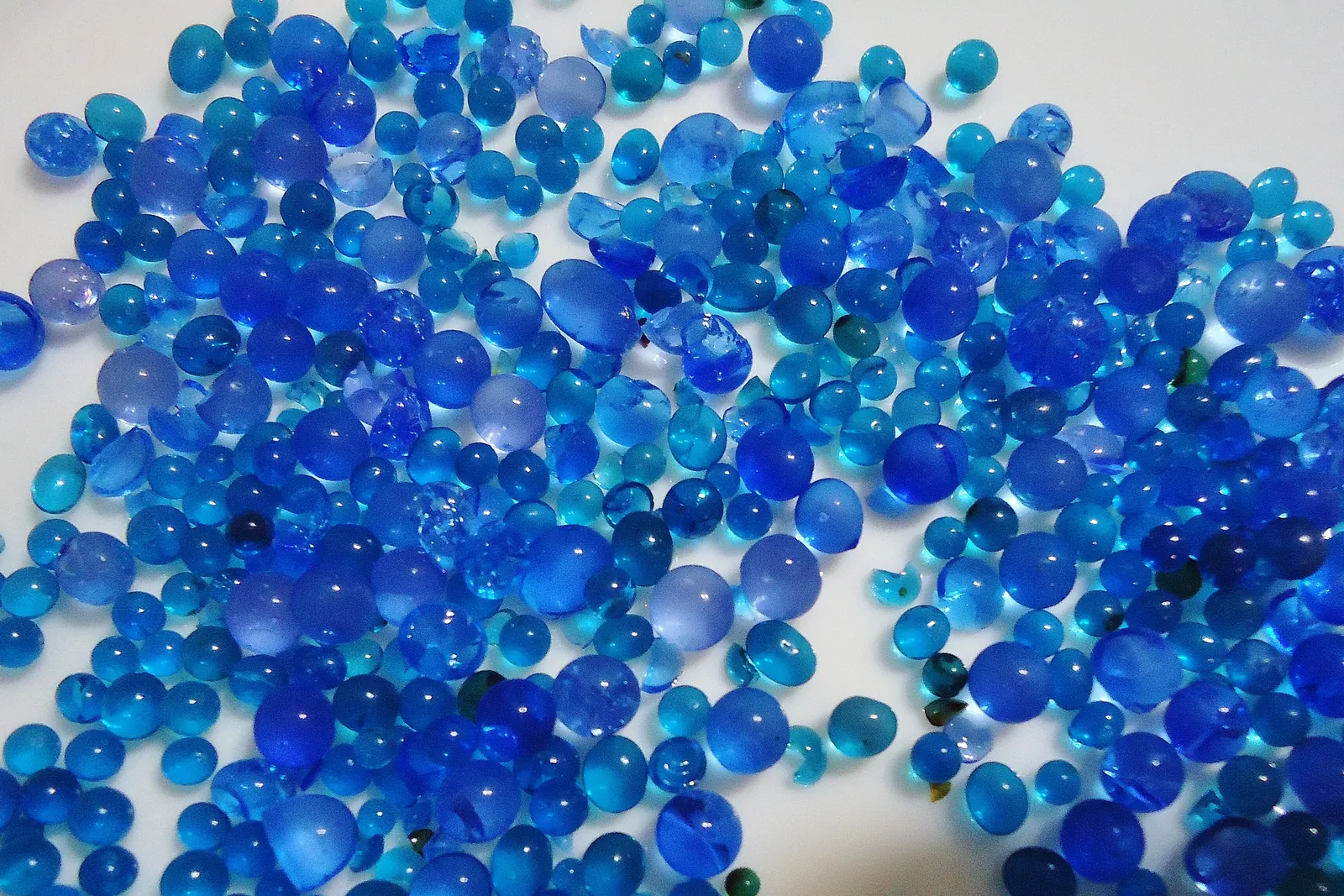
Silica gel is the usual desiccant, sold as loose beads or sachets, and the indicating grades change colour as they load up, orange to green or blue to pink depending on the type. Loose beads in a jar with holes work as well as sachets and are easier to recharge. Recharging means driving the water back off with heat, and Bambu Lab's instruction for the silica gel it ships is not to exceed 100 °C, since overheating damages the structure of the gel. That is still above anything the filament tolerates, so the desiccant is baked on its own, in a ceramic, glass or foil container rather than a plastic one.
For the container, a vacuum bag or a gasketed box both work, and the box is easier to live with because it opens and closes without a pump. Add more desiccant than looks necessary: the air in the box holds very little water, and almost all of the load comes from what the filament and the container walls give up.
Printing straight from a sealed box is the arrangement that survives a long print. The filament runs out through a bulkhead fitting and PTFE tube, and never meets room air. This is what the drying chambers built into multi-material units are doing, and it is why Bambu Lab lists desiccant protection during use as required for TPU, PC, PVA and the filled nylons.
The spool has a temperature rating of its own, and it is often lower than the filament's. Prusa states that the plastic sides of a Prusament spool are pressed into a cardboard core, that heating makes the plastic expand and the cardboard stay expanded when it cools, and that the spool can be heated safely only to 45 °C before it loosens. Its newer spools are rated to 90 °C, and the high temperature grey one to 150 °C. UltiMaker's spools are a polypropylene copolymer that softens around 80 °C, which caps drying regardless of what the material wants. Bambu Lab adds that some third-party spools are not heat resistant enough and may deform.
Cardboard spools deserve a note. They absorb water themselves and hold it against the filament, so a cardboard spool in a damp workshop is a slower version of leaving the plastic out. Move the coil to a plastic spool or keep the whole thing sealed.
What drying cannot undo
Drying removes water. It does not put molecular weight back. If a spool has already been printed wet, the chains cut by hydrolysis in the melt stay cut, and those parts are weaker than the data sheet whatever is done to the spool afterwards. The same applies to filament that has been dried and redried many times, since every pass through the hot end is another chance for the reaction.
A printed part that has since absorbed water is a different case. Nylon parts take up moisture from the air after printing and soften as they do, which is what the wet column in Polymaker's table is measuring, and that change is reversible by drying the part. Whether it is worth doing depends on whether the part is a prototype or something that has to hold a load.
Nothing here is a substitute for buying less filament at a time. A spool used within a few weeks of opening never gets the chance to become a problem, and the materials that need the most care are the ones people buy for one job and leave on the shelf for a year. For the filaments where moisture is least of the worries, the comparison of PLA, PETG and ABS covers the other trade-offs, and the fibre filled grades add nozzle wear to the list.
Frequently asked questions
At what temperature should I dry 3D printer filament?
Below the softening point of the polymer. Bambu Lab's forced-air oven figures are 50 °C for PLA, 60-65 °C for PETG, 70 °C for TPU, 75-85 °C for ABS, ASA, PC and nylon, and 100-140 °C for PPA-CF and PPS-CF. Polymaker gives 55 °C for PLA and 65 °C for PETG on its own data sheets, so brands differ by a few degrees for the same material.
How long does it take to dry filament?
Between 4 and 18 hours depending on material and method. Bambu Lab lists 8 hours in a forced-air oven for most filaments, 8-12 hours for nylon, PVA and PET-CF, and 12 hours in its AMS units, rising to 18 hours for TPU and PVA. Diffusion through a tightly wound spool is what makes it slow.
How do I know if my filament is wet?
Listen and look. Damp filament pops or hisses at the nozzle, sometimes with visible steam, and the extruded bead comes out wider, matt and foamy instead of glossy. Bambu Lab lists stringing, oozing, holes, rough surfaces and reduced strength as the results. Translucent PETG turns cloudy because the bubbles scatter light.
Which filaments need drying the most?
Nylon, polycarbonate, PVA and TPU, along with filled grades such as PA-CF and PET-CF. Bambu Lab marks drying as required for those and only recommended for plain PLA, PETG, ABS and ASA. Polyamides absorb the most because the amide group on every repeat unit hydrogen bonds with water.
Can I dry filament in a kitchen oven?
The manufacturers disagree. Bambu Lab says not to, because kitchen ovens distribute heat unevenly and the area near the element damages the spool. Prusa allows it with an external thermometer while warning that home ovens measure temperature poorly and many cannot go low enough for PLA. Polymaker permits a household convection oven at a low stable temperature. If you do use one, Bambu Lab's minimum cavity for a 200 mm spool is 250 mm deep by 250 mm wide by 90 mm high.
Does drying filament restore its strength?
It restores printability, and for a nylon part that has absorbed water after printing, drying the part does reverse the softening. What it cannot undo is hydrolysis: water in the melt cuts polymer chains, molecular weight drops, and parts already printed from wet filament stay weaker than the data sheet.
How should filament be stored between prints?
Sealed with desiccant, and moved there as soon as the spool is cool. A vacuum bag or a gasketed box both work, silica gel is the usual desiccant, and indicating grades change colour as they load. Feeding the printer through a bulkhead fitting from a sealed box keeps the filament out of room air during long prints.
How do I recharge silica gel?
Drive the water off with heat, keeping below the supplier's ceiling. Bambu Lab says not to exceed 100 °C for the silica gel it ships, because overheating damages the gel structure, and to use ceramic, glass or foil rather than plastic containers. That is well above what filament tolerates, so the desiccant is baked alone.
Sources
- Bambu Lab Wiki: Filament drying guide
- Bambu Lab Wiki: Filament drying guide for AMS 2 Pro and AMS HT
- Polymaker Wiki: PolyMide CoPA technical data sheet
- Polymaker Wiki: PolyLite PLA technical data sheet
- Polymaker Wiki: PolyLite PETG technical data sheet
- Polymaker Wiki: PolyFlex TPU95 technical data sheet
- Polymaker Wiki: Technical data at a glance
- Polymaker Wiki: Printing tips by material type
- Polymaker Wiki: PLA-CF technical data sheet
- Polymaker Wiki: PolyLite ABS technical data sheet
- Polymaker Wiki: Polymaker ASA technical data sheet
- Polymaker Wiki: PolyLite PC technical data sheet
- Polymaker Wiki: PolyDissolve S1 technical data sheet
- Polymaker Fiberon PA6-CF20 technical data sheet
- Polymaker Fiberon PA12-CF10 technical data sheet
- Polymaker Fiberon PET-CF17 technical data sheet
- Polymaker Fiberon PETG-rCF08 technical data sheet
- Prusa Knowledge Base: Polyamide (Nylon)
- Prusa Knowledge Base: Drying filament
- Prusa Knowledge Base: Polycarbonate (PC)
- Prusa Knowledge Base: PLA
- Prusa Knowledge Base: PETG
- Prusa Knowledge Base: ASA
- Prusa Knowledge Base: Flexible materials
- Prusa Knowledge Base: Water-soluble materials (PVA/BVOH)
- Prusament PLA technical data sheet
- Prusament PETG technical data sheet
- Prusament ASA technical data sheet
- Prusament PC Blend technical data sheet
- Wikipedia: Hygroscopy
- Wikipedia: Hydrolysis
- Wikipedia: Silica gel
- Wikipedia: Desiccant
- Wikipedia: Glass transition
- Wikipedia: Nylon 6
- Wikipedia: Polylactic acid
- Wikipedia: Polyamide
- Wikipedia: Fused filament fabrication