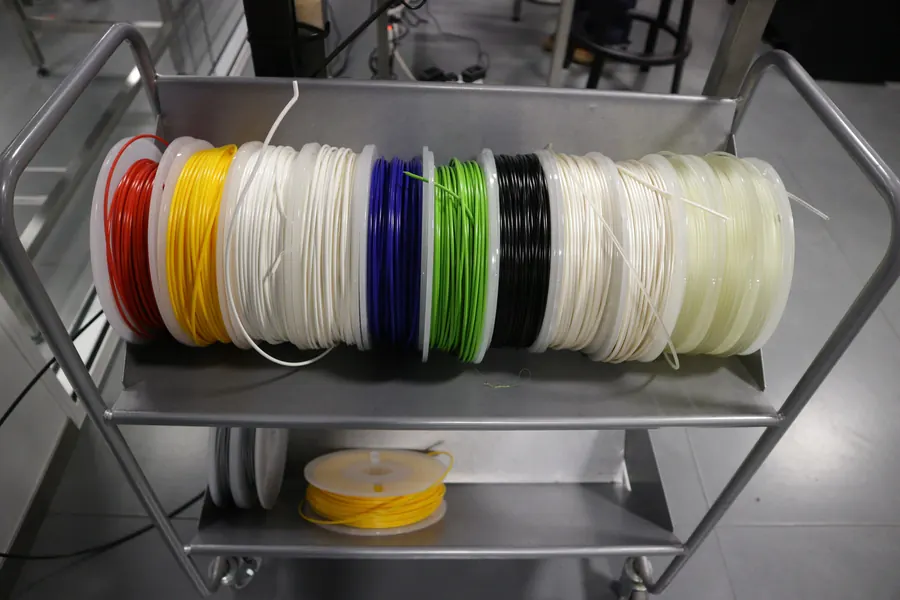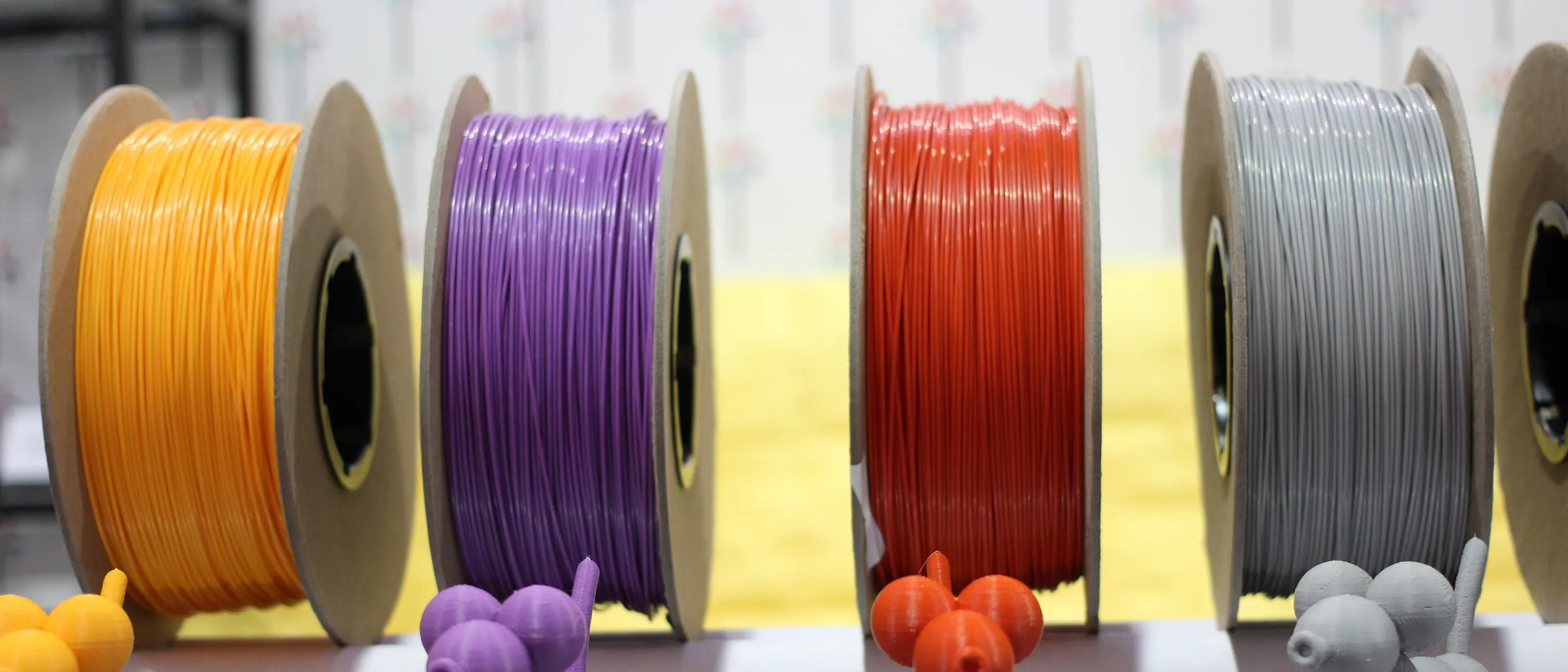
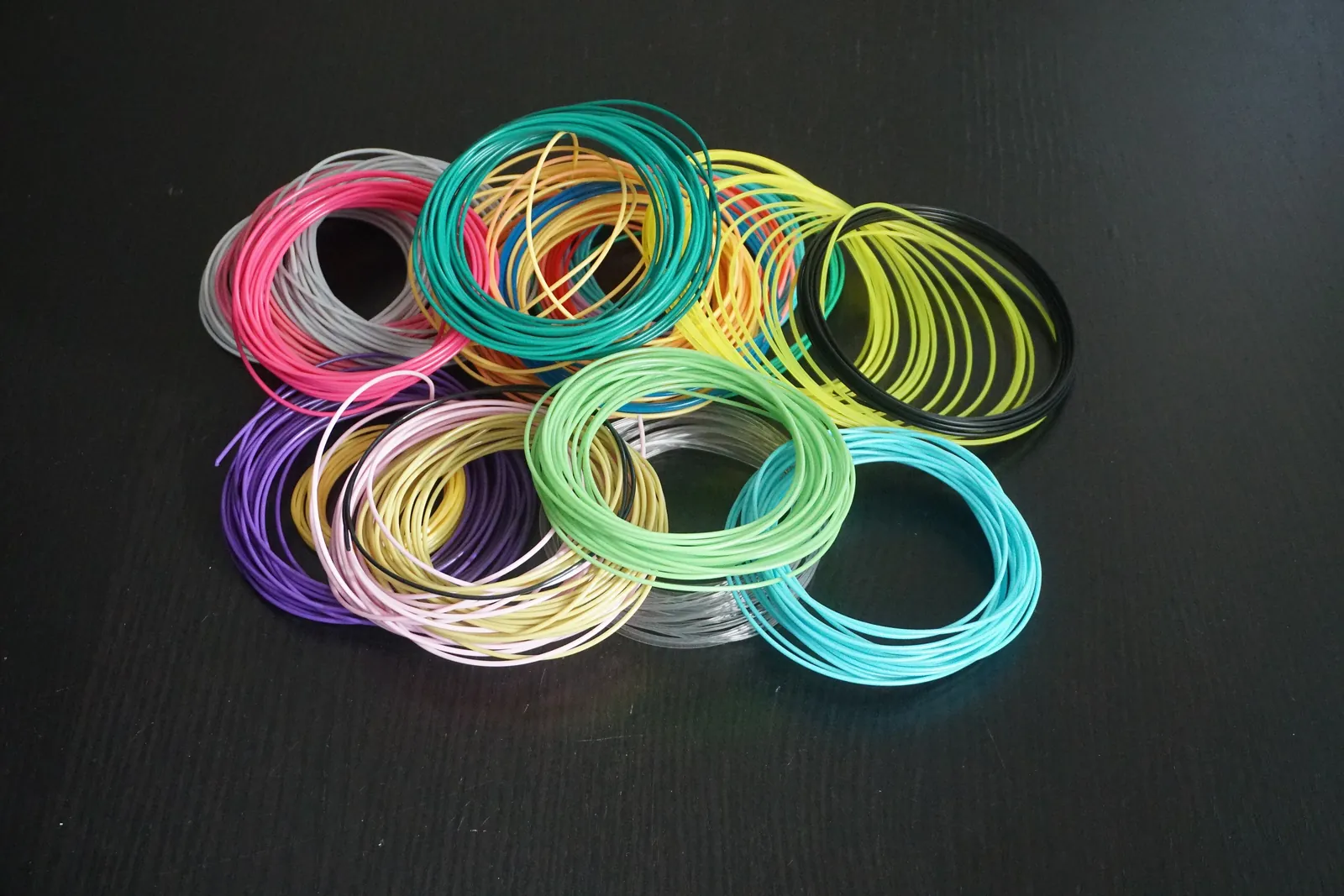
- PLA, PETG, ABS, ASA, TPU, nylon and polycarbonate are the main FDM filament types, alongside carbon fibre, glass fibre, wood and metal-filled versions and soluble PVA, BVOH and HIPS support materials.
- Printed PLA has a heat deflection temperature of about 55-60 °C, PETG 68-78 °C, ASA and ABS roughly 86-118 °C and polycarbonate blends about 111-114 °C, depending on brand and test load.
- FDM parts are weaker across their layers than along them: Polymaker's PLA falls from 52.3 MPa tensile strength in XY to 40.5 MPa in Z.
- Nylon absorbs water readily, and Polymaker's PA6/66 copolymer drops from 78 MPa tensile strength dry to 34 MPa wet.
- Carbon fibre, glass fibre, Kevlar and metal-filled filaments are abrasive and need a hardened steel nozzle, because brass nozzles wear quickly.
- A food-contact certified filament does not make a printed part food safe, because layer crevices are hard to clean and brass nozzles wear into the print.
The main 3D printing filament types are PLA, PETG, ABS, ASA, flexible TPU, nylon and polycarbonate, plus filled versions of these (carbon fibre, glass fibre, wood, metal) and dissolvable support materials such as PVA and HIPS. Choose by the conditions the part has to survive. PLA is the easiest to print but softens at around 55-60 °C. PETG adds toughness and a little more heat resistance. ASA, ABS and polycarbonate cope with heat and sunlight better but need a hot bed and usually an enclosure. TPU is for parts that must bend, and nylon suits wearing parts if you can keep it dry.
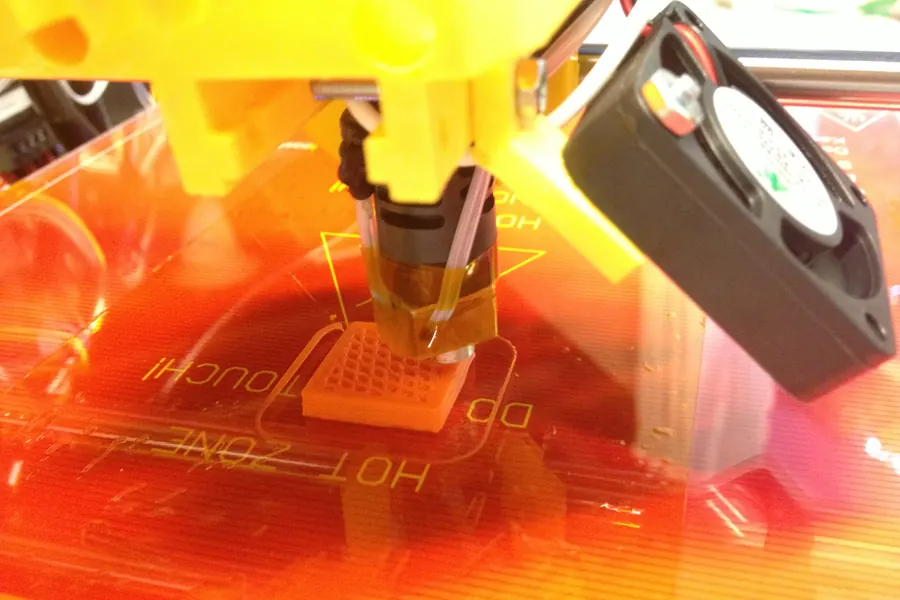
All of these are thermoplastics fed as a strand into a fused filament fabrication printer (FFF, often called FDM), which melts the filament and lays it down line by line. The figures on this page come from manufacturer technical data sheets and guides from Prusa, Polymaker and others, and from textbook polymer values. Brands differ, by 10 °C or more on heat resistance for the same polymer name, so treat each number as typical for that product and check the data sheet of the spool you buy.
3D printing filament comparison chart
The chart compares the common filament types on the properties that decide most material choices. Temperatures are the ranges given in manufacturer data sheets and guides. Heat resistance is shown as the glass transition temperature (Tg) where a textbook or brand value exists, and as the heat deflection temperature (HDT) of printed or moulded test bars at the lower 0.45 MPa load. A later section explains the difference.
| Material | Nozzle (°C) | Bed (°C) | Heat resistance | Strength and stiffness | Flexibility | Moisture sensitivity | Enclosure | Fumes | Typical uses |
|---|---|---|---|---|---|---|---|---|---|
| PLA | 190-230 | 40-60 | Tg 60-65 °C; HDT 55-60 °C | Stiff (modulus 2.3-3.4 GPa), low elongation | Low | Low (0.13% in 24 h) | Not needed | Lactide, about 4-5 µg/min in one study | Prototypes, models, figurines, room-temperature jigs |
| PETG | 230-260 | 70-90 | Tg about 80 °C; HDT 68-78 °C | Tough; modulus 1.5-2.1 GPa | Moderate | Low (0.07% in 24 h) | Not needed | Not measured in the cited study | Mechanical parts, outdoor parts below 80 °C, waterproof parts |
| ABS | About 255 | 80-110 | Tg about 105 °C; HDT 100-118 °C | Tough; about 33-36 MPa printed XY | Low | Low | Needed | Styrene, about 10-110 µg/min | Housings, acetone-smoothed parts, indoor parts that get warm |
| ASA | 250-270 | 105-115 | Tg about 100 °C; HDT 93-103 °C | Similar to ABS; 42-44 MPa printed XY | Low | Low (0.16% in 24 h) | Needed for large parts | Prusa warns of potentially dangerous fumes | Outdoor parts, parts in direct sun, car exterior parts |
| TPU (flexible) | 210-245 | 25-75 | Not listed on the Polymaker TPU95 data sheet | Low stiffness, very tough | High (Shore 60A-95A; over 500% elongation) | Moderate to high | Not needed | Not measured in the cited study | Gaskets, seals, RC tyres, bumpers, grips, belts |
| Nylon (PA6, PA6/66, PA12) | 250-285 | About 110 | Tg 47 °C (PA6), 66 °C (CoPA); HDT 111 °C (CoPA) | Strong and tough, low friction; 78 MPa XY dry, 34 MPa wet (CoPA) | Flexible in thin sections | Very high | Recommended | Caprolactam, about 2-180 µg/min | Wearing and sliding parts, technical parts |
| Polycarbonate (PC) | 265-285 | 100-120 | Tg 147 °C (pure PC); HDT 111-114 °C | High strength and impact resistance; 63-69 MPa printed XY | Low | Dry before printing | Recommended | Caprolactam at low rates from one PC filament | Hot or high-impact technical parts, fan shrouds |
| Carbon or glass fibre filled | 240-285 | 70-110 | Depends on base; up to 215 °C HDT (PA6-CF) | Stiffer, lower impact strength, weaker layer bonds | Low | As base polymer | As base polymer | As base polymer | Frames, drone and RC parts, hot technical parts |
| Wood or metal filled | 190-270 | 60-100 | As base polymer | Weaker than the unfilled base | Low | As base polymer | As base polymer | Caprolactam from one imitation-wood filament | Decorative parts, weighted parts |
| PVA / BVOH | Matched to model material | Per slicer profile | Not relevant (dissolved away) | Support use only | Low | Very high | Not needed | No data | Water-soluble supports for PLA; BVOH for PETG |
| HIPS | 225-255 | 100-110 | No brand value collected | Moderate, lightweight | Low | Low | Not stated by Prusa | Styrene | Limonene-soluble supports |
Read the heat column with the test conditions in mind. The same PETG polymer is rated 68 °C by Prusament and 78 °C by Polymaker's PolyLite line, and Polymaker's three ABS grades span 100-118 °C. The three most common materials get a side-by-side treatment on PLA vs PETG vs ABS.
Types of 3D printing filament and their uses
PLA
PLA (polylactic acid) is the default filament for most desktop printers. Wikipedia describes it as the most widely used FDM material because of its low melting point, low thermal expansion and good layer adhesion. It prints at about 190-230 °C on a 40-60 °C bed with the part cooling fan at full speed, and it needs no enclosure.
Heat is its weak point. PLA's glass transition sits around 60-65 °C, data sheets put the HDT of printed PLA at 55 °C (Prusament) to 60 °C (Polymaker PolyLite), and Prusa's guide says it softens and deforms above 60 °C. A PLA part in a car or in summer sun can sag.
At room temperature PLA is stiff: Prusament lists a printed tensile modulus of 2.3 GPa, against 1.5 GPa for its PETG, and a tensile yield strength of about 51 MPa. It stretches little, 6.3% at break along the layers and 1.8% across them in Polymaker's tests, so an overloaded part cracks with little warning. Heat-resistant grades reach their rating only after oven annealing; Polymaker's HT-PLA goes from an HDT of 61 °C as printed to 107 °C annealed.
PETG
PETG is PET in which some ethylene glycol is replaced by cyclohexanedimethanol, a larger molecule that interferes with crystallisation and leaves a clear, amorphous plastic. It prints at about 230-260 °C on a 70-90 °C bed, and Prusa describes it as barely shrinking or warping, so large parts print well without an enclosure.
PET's textbook Tg is 67-81 °C, Polymaker lists 81 °C for its PETG, and printed HDT values run from 68 °C (Prusament) to 78 °C (Polymaker PolyLite). Prusa makes parts of its own printers from PETG and recommends it for indoor and outdoor mechanical parts below about 80 °C.
PETG is tougher and less stiff than PLA: in Prusament's Charpy tests unnotched PETG bars did not break, while PLA bars broke at 13 kJ/m². It strings, supports are hard to remove, and it bonds so strongly to the print surface that Prusament's data sheet specifies glue stick on smooth PEI.
ABS
ABS (acrylonitrile butadiene styrene) has a Tg of about 105 °C and a useful service range that Wikipedia gives as -20 to 80 °C; Polymaker's printed HDT figures for its ABS grades run from 100 °C to 118 °C. Prusa prints it at about 255 °C on an 80-110 °C bed. It shrinks by about 1-2% as it cools, which makes it warp, and Prusa's guide calls for an enclosure and a high ambient temperature.
ABS dissolves in acetone, so parts can be vapour smoothed, and it sands well wet or dry. Outdoors, UV light and heat cause photo-oxidation that breaks its polymer chains, and parts turn yellow and brittle; Prusa points to ASA instead. Printing ABS releases styrene, which Azimi and colleagues measured at roughly 10-110 µg per minute from ABS and HIPS filaments.
ASA
ASA (acrylonitrile styrene acrylate) prints much like ABS and is used where parts face the weather, such as siding, car exterior parts and garden furniture. Wikipedia credits it with about ten times the weathering and UV resistance of ABS. Its Tg is about 100 °C; Prusament measures an HDT of 93 °C at 0.45 MPa and 86 °C at 1.8 MPa, and Polymaker lists 103 °C for its ASA. Prusament recommends 260 ± 10 °C at the nozzle and 110 ± 5 °C on the bed, and Prusa advises an enclosure for large parts and warns of potentially dangerous fumes.
TPU and other flexible filaments
TPU (thermoplastic polyurethane) and other thermoplastic elastomers are the rubber-like filaments, graded by Shore A hardness. Prusa gives 60A-90A as the usual range for TPU filament, and general-purpose products such as Polymaker PolyFlex TPU95 sit at 95A. The softer the grade, the harder it is to print. Polymaker measures 551% elongation at break for TPU95, and Prusa reports strong layer adhesion and good solvent resistance.
Flexibles print at roughly 210-245 °C on a 25-75 °C bed and must go slowly: Prusa suggests about 20 mm/s and no more than 30-40 mm/s, because a soft strand pushed faster can tangle in the extruder gears or clog the nozzle. Bridges, overhangs and support removal are harder than with rigid filaments. TPU absorbs moisture and prints poorly when wet; Polymaker dries TPU95 at 70 °C for 8 hours. Typical uses are gaskets, seals, RC tyres, shoe soles, belts and spacer washers.
Nylon (polyamide)
Nylon filaments are polyamides such as PA6, PA12 and PA6/66 copolymers. Prusa describes polyamide as having excellent thermal and mechanical resistance and low friction, tough in large volumes and flexible in thin layers, which suits sliding and load-bearing technical parts. It prints at around 250-285 °C, and Prusa recommends a 110 °C bed, a dedicated nylon build sheet, an enclosure against warping and good ventilation because of its strong odour and ultrafine particles.
Polyamides are hygroscopic, and the figures depend on grade and conditions. Wikipedia gives up to 2.4% by weight for nylon 6, Polymaker's PA6/66 copolymer (PolyMide CoPA) reached 6.16% after 48 hours in 60 °C water, and Prusa warns that badly stored filament can take up to 10% of its weight. PA12 absorbs less, which Wikipedia attributes to its long hydrocarbon chain.
Moisture hurts twice. Wet filament boils in the nozzle, leaving bubbles, uneven layers and a rough surface, and absorbed water weakens the finished part: CoPA falls from 78 MPa tensile strength dry to 34 MPa wet along the layers, and from 46 MPa to 14 MPa across them. The nylon 6 Tg of 47 °C understates heat resistance under light load, since Polymaker measures an HDT of 111 °C at 0.45 MPa for CoPA, falling to 70 °C at 1.8 MPa.
Polycarbonate
Polycarbonate (PC) is used where a part needs heat resistance and impact strength together. Pure PC has a Tg of 147 °C and an Izod impact strength of 600-850 J/m. Many desktop PC filaments are blends: Prusament PC Blend has an HDT of 113 °C at 0.45 MPa and 93 °C at 1.8 MPa, a printed tensile yield strength of 63 MPa and the best interlayer adhesion in Prusament's range at 21 MPa. Polymaker's PolyLite PC is rated at 111 °C.
Wikipedia notes that PC is hard for hobbyists to print because of its high melting point, poor bed adhesion, warping and moisture uptake. Prusa recommends about 275 °C at the nozzle and 110-115 °C on the bed, an enclosure, drying before printing and glue stick as a separating layer on smooth PEI. Prusa suggests it for fan shrouds, battery components and similar technical parts.
Carbon fibre and glass fibre filled filaments
Composite filaments mix chopped carbon fibre, glass fibre or aramid (Kevlar) into a base such as PLA, PETG, nylon or PC. According to Prusa, the fibres improve dimensional stability, heat resistance and tensile yield strength and reduce warping, while lowering impact resistance and layer adhesion. The gain depends on the base: Polymaker's PA6-CF20 reaches an HDT of 215 °C at 0.45 MPa, while its PLA-CF sits at 54 °C with a lower XY tensile strength (31 MPa) than its plain PolyLite PLA (52 MPa). The carbon fibre and graphene filament page covers composite and nano-filled filaments in depth, and nano-fillers in general are a recurring subject on nanopack.org.
Wood, metal and other filled filaments
Decorative filled filaments are a base polymer, usually PLA, loaded with powder; Simplify3D describes wood fill as PLA combined with cork, wood dust or similar. Some metal fills are sold for their weight, such as Prusament PETG Tungsten 75% for radiation shielding. Prusa gives 190-270 °C at the nozzle and 60-100 °C on the bed, depending on the base. The particles weaken the part and its layer bonds, wood fills need a nozzle of at least 0.6 mm to avoid clogs, and metal fills are highly abrasive. Metal-filled prints can be wet sanded up to 1500 grit and polished; wood-filled prints can be stained.
Support materials: PVA, BVOH and HIPS
Soluble supports let a printer with two extruders or a multi-material unit build supports that wash away. PVA and BVOH dissolve in water: Prusa pairs PLA with either, but for PETG only BVOH works in practice. The print soaks in water no hotter than 45 °C for a few hours to overnight. Both are very hygroscopic, and Prusa says an exposed spool deteriorates within a few months, so it goes back into a sealed bag with silica gel after each use.
HIPS (high-impact polystyrene) dissolves in limonene and prints at 225-255 °C on a 100-110 °C bed. Prusa's soluble-support article names it as the option for ABS, but its HIPS guide warns that ABS and ASA also partly dissolve in limonene. Test the pairing on a small sample first.
Which filament for which job
Start from the environment the part will live in, then pick the easiest material that survives it.
Which filament for outdoor parts
ASA is the usual pick for parts in sunlight, since it prints like ABS with far better UV resistance. PETG also works outdoors: Prusa rates it for exterior use below 80 °C, and it resists water and humidity. ABS yellows and becomes brittle in UV, so it suits only short-lived outdoor parts. PLA's low softening point rules it out for anything in summer sun, because sunlit surfaces run far hotter than the air.
Parts near a car dashboard
In a study of a car parked in the sun in Baghdad, Aljubury and colleagues measured a dashboard temperature of 99 °C in June, with 44 °C outside air and 70 °C in the cabin. Against that, PLA (HDT 55-60 °C) and PETG (68-78 °C) will deform. ASA and ABS sit close to the peak, at roughly 86-118 °C depending on load and brand, so they are safer for mounts below the dash than on top of it. Polycarbonate (111-114 °C at 0.45 MPa) or a fibre-filled nylon gives more margin, and a sunshade helps: shading was the most effective measure in that study, cutting the dashboard's temperature rise by up to 54.4 °C.
Can 3D printed parts be food safe?
A filament sold as food-contact compliant does not make a printed part food safe. Round extruded lines leave narrow crevices between layers, and Prusa calls those grooves a seedbed for bacteria because they are almost impossible to clean. Prusa does not recommend any filament for dishes or food containers.
Certification covers the raw material, often with exceptions: Prusa quotes FDA approvals worded "approved except red, orange, and pink". Formlabs names the relevant rules as FDA 21 CFR in the United States and Regulation (EU) No 10/2011 in the European Union. Brass nozzles wear into the print, so Prusa suggests stainless steel for food-contact work. Formlabs adds that PLA and nylon soften at around 60-70 °C, which rules them out of the dishwasher. If a part must touch food, keep contact brief, use a certified uncoloured filament and a stainless nozzle, and seal the surface with a food-safe certified epoxy. Commercial packaging is a separate field; see nanotechnology in food packaging and active vs intelligent packaging.
Mechanical parts
For brackets, holders and clamps at room temperature, PETG is a sensible start: tougher than PLA and printable without an enclosure. PLA suits stiff jigs that never get warm. For gears, hinges and sliding parts, nylon's toughness and low friction make it the better material if you can dry it and print it hot, and loads at high temperature point to PC or fibre-filled nylon. With any material, orient the part so the main load runs along the layers.
Flexible parts
TPU covers most flexible needs, from gaskets and bumpers to grips and cable strain reliefs. A 95A grade suits firm parts that should still give; softer grades need an extruder that handles them well. Thin nylon sections give a stiffer flex for clips.
Miniatures and fine detail
For tabletop miniatures, jewellery and dental models, resin printing is a different technology and usually the better one. Resin printers (SLA and MSLA) cure liquid photosensitive resin layer by layer, with a minimum layer height of 25-100 microns according to Prusa, and the surface comes out almost smooth. The Prusament test bars quoted here were printed at 200 micron (0.20 mm) layers. Resin prints need washing in isopropyl alcohol and UV curing, and Prusa advises keeping resin off skin and not breathing its vapours.
What the numbers on a spool and data sheet mean
A spool label usually gives only nozzle and bed ranges. The technical data sheet (TDS) holds the numbers that predict how a part behaves, and they compare fairly only when you know what each test measured.
Nozzle and bed temperature ranges
The printed range is a starting window, and brands tune grade, pigments and additives. For PETG, Prusament's data sheet gives 250 ± 10 °C, Prusa's guide suggests 230 °C for the first layer and 240 °C after, and Polymaker gives 230-260 °C. A temperature tower printed with each new spool shows which setting gives good layer bonding without heavy stringing.
Glass transition vs heat deflection temperature
Glass transition temperature (Tg) is where an amorphous polymer changes gradually and reversibly from a hard, glassy state to a rubbery one. It spans a range, and the value depends on method and heating rate; Polymaker measures it by DSC at 10 °C per minute. Tg is always below the melting point.
Heat deflection temperature (HDT) is a load test. In ASTM D648 a bar is loaded in three-point bending at 0.455 MPa or 1.82 MPa and heated at 2 °C per minute until it deflects 0.25 mm; data sheets often cite the equivalent ISO 75. Because it includes a load, HDT is closer to service conditions, and the load changes the answer: Prusament ASA reaches 93 °C at 0.45 MPa and 86 °C at 1.8 MPa, while Polymaker's CoPA nylon drops from 111 °C to 70 °C. Compare HDT only at the same load, and check for annealing, which Polymaker applies to its nylon test bars.
Tensile strength in XY and Z
Some brands test raw filament, some test printed bars lying flat (XY), and some also test bars printed upright so the load pulls the layers apart (Z). Polymaker's figures show the gap: PLA drops from 52.3 MPa in XY to 40.5 MPa in Z, PETG from 50.8 to 42.8 MPa, and CoPA nylon from 78.0 to 45.8 MPa. Elongation drops further, from 6.3% to 1.8% for PLA and from 8.4% to 3.3% for PETG.
Prusament reports the across-layer figure as a separate interlayer adhesion value: 17 MPa for PLA, 18 MPa for PETG, 11 MPa for ASA and 21 MPa for PC Blend, against printed tensile yield strengths of 51, 47, 42 and 63 MPa. Its "vertical xz" bars give results close to the flat ones, so they do not show the across-layer weakness.
Why FDM parts are anisotropic
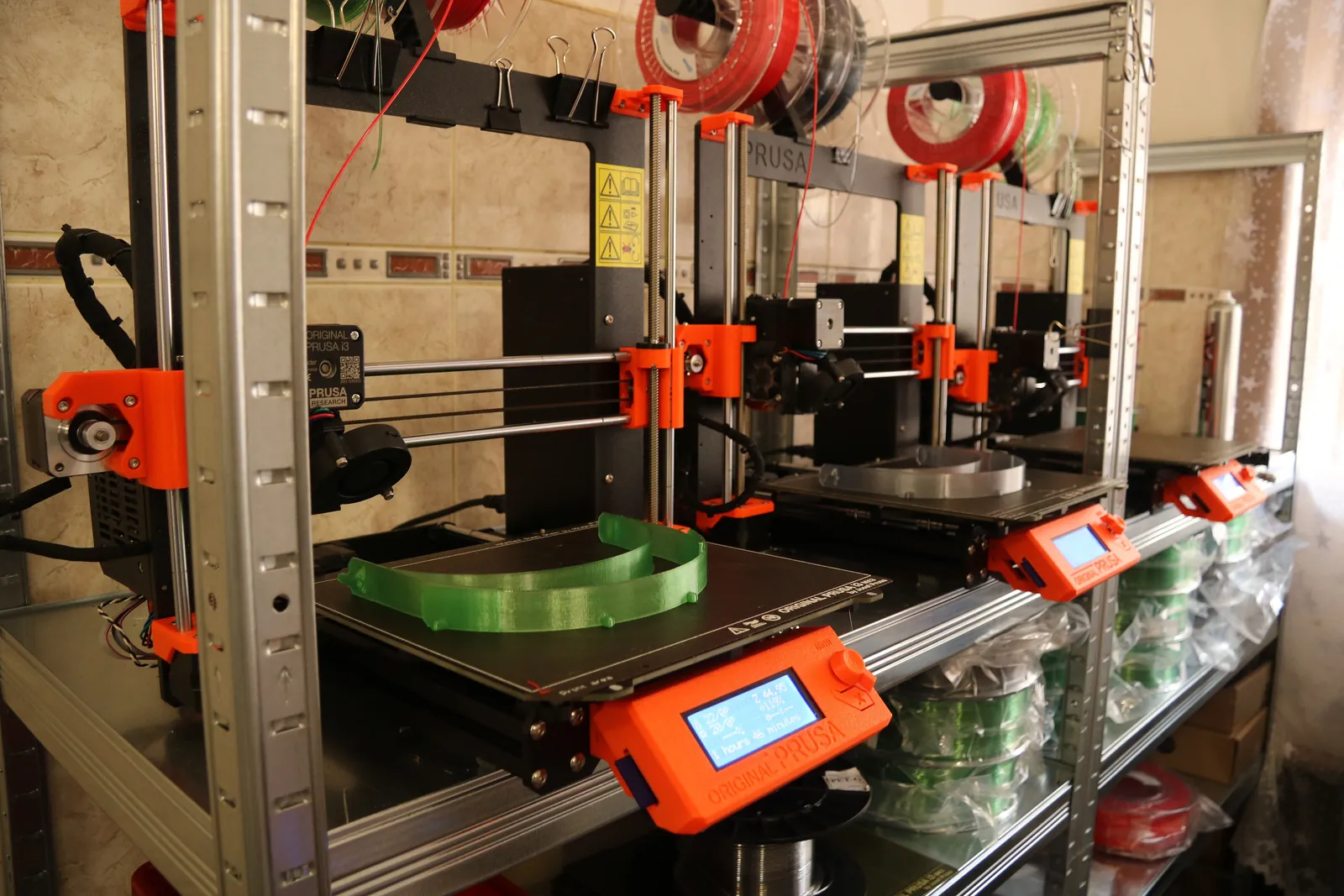
An FDM part is a stack of extruded lines. Along a line, load is carried by continuous polymer. Between layers it is carried only by the bond formed when hot plastic met the cooler layer below, and the round lines leave grooves at the joins. The same part is therefore stronger in some directions than in others.
The size of the effect depends on material and settings: Aldawood and colleagues, testing PLA and PC in 2025, found orientation effects highly conditional on layer height and other parameters. Printing also costs strength compared with moulding. Wikipedia gives 43 MPa for the tensile strength of ABS, while Polymaker's printed ABS bars reach about 33-36 MPa even in XY. Orient parts so the main stress runs along the layers, and avoid tall thin features that will be bent across them.
Moisture absorption figures
Data sheets quote moisture absorption as weight gained over a set time at a set humidity. Prusament measures at 24 °C and 22% relative humidity: PETG gains 0.07% in 24 hours, PLA 0.13% and ASA 0.16%. Nylon soaked in warm water is in another range, as the 6.16% CoPA figure shows.
How to dry and store filament
Damp filament prints badly, because water turns to steam in the hot end. Nylon, PC, TPU and the water-soluble supports need the most care; PLA and PETG absorb less, but Polymaker still gives drying settings for both. Dry below the softening point: Bambu Lab warns that PLA, PVA and TPU can stick together or deform on a static spool. Polymaker dries PLA at 55 °C for 6 hours, just under its 61 °C Tg, PETG at 65 °C for 6 hours, TPU95 at 70 °C for 8 hours and CoPA nylon at 100 °C for 8 hours. Prusa gives at least 4 hours below 90 °C for its nylon, so brands set different limits, and the spool itself must survive the temperature.
For storage, keep open spools sealed with fresh silica gel, as Prusa advises for soluble supports, or feed the printer from a dry box. Prusa's drybox for hygroscopic materials uses silica gel to keep humidity low during long prints.
Abrasive filaments and nozzle wear
Most printers ship with brass nozzles, which conduct heat well but wear quickly against hard particles. Prusa lists carbon fibre, glass fibre, Kevlar, metal-filled and ceramic-filled filaments as abrasive and says a brass nozzle will degrade very quickly with them. The answer is a hardened steel nozzle, such as Prusa's coated ObXidian.
Hardened steel conducts heat differently, and Prusa suggests raising the hotend temperature by about 5 °C after switching. Fibre fills also clog more easily, so Prusa recommends at least a 0.4 mm nozzle, 0.2 mm layers and a cold pull before starting. Unfilled PLA, PETG, ABS, ASA, TPU, nylon and PC are not on Prusa's abrasive list. The composite filament page goes further into fibre fills and nozzle choice.
Fumes and ventilation
In a chamber study of five desktop printers with up to nine filaments, Azimi and colleagues measured ultrafine particle emission rates from about 100 million to 100 billion particles per minute, varying mainly with filament material. The largest vapour emissions were caprolactam from nylon-based and imitation wood and brick filaments (about 2-180 µg/min), styrene from ABS and HIPS (about 10-110 µg/min) and lactide from PLA (about 4-5 µg/min). The authors advise caution when running many printer and filament combinations in poorly ventilated rooms or without combined gas and particle filtration. An enclosure with a filter or an exhaust to outside air helps most with ABS, ASA, HIPS and nylon.
Frequently asked questions
What are the main types of 3D printing filament?
The common FDM filaments are PLA, PETG, ABS, ASA, TPU (flexible), nylon and polycarbonate. Filled versions add carbon fibre, glass fibre, wood or metal powder, and PVA, BVOH and HIPS are used as dissolvable support materials.
What is the strongest 3D printing filament?
In tensile tests on printed bars, dry nylon and polycarbonate score highest among unfilled filaments, for example 78 MPa in XY for Polymaker PolyMide CoPA and 63-69 MPa for PC grades from Prusament and Polymaker. Carbon fibre filled nylon goes higher, with Polymaker's PA6-CF20 at 109 MPa in XY. Every printed part is weaker across its layers than along them.
Which filament is best for outdoor use?
ASA is the usual choice for parts in sunlight because it has about ten times the weathering and UV resistance of ABS. PETG also works outdoors below about 80 °C, while ABS yellows and turns brittle in UV and PLA softens at around 55-60 °C.
Which 3D printing filament handles heat best?
Among unfilled filaments, polycarbonate blends (HDT about 111-114 °C at 0.45 MPa), ABS (100-118 °C) and ASA (93-103 °C) handle heat best, depending on brand. Fibre-filled nylons go much higher, with Polymaker's PA6-CF20 rated at 215 °C.
Is PLA filament food safe?
PLA as a raw material can carry food-contact approval, but a printed PLA part is not food safe in practice because bacteria collect in the crevices between layers and brass nozzles shed metal into the print. PLA also softens at around 60 °C, so it cannot go in a dishwasher or microwave.
Do I need to dry 3D printing filament?
Nylon, polycarbonate, TPU and PVA or BVOH should be dried before printing, because absorbed water turns to steam in the nozzle and leaves bubbles and rough layers. Dry below the softening point, for example 55 °C for PLA, 65 °C for PETG and 70 °C for TPU in Polymaker's settings.
Sources
- Prusa Knowledge Base: PLA
- Prusa Knowledge Base: PETG
- Prusa Knowledge Base: ABS
- Prusa Knowledge Base: ASA
- Prusa Knowledge Base: Flexible materials
- Prusa Knowledge Base: Polyamide (Nylon)
- Prusa Knowledge Base: Polycarbonate (PC)
- Prusa Knowledge Base: Composite materials (filled with carbon, kevlar or glass)
- Prusa Knowledge Base: Composite materials (with metal or wood particles)
- Prusa Knowledge Base: HIPS
- Prusa Knowledge Base: Water-soluble materials (PVA/BVOH)
- Prusa Knowledge Base: Prusa nozzle types for Nextruder printers
- Prusa Knowledge Base: Food safe FDM printing
- Prusa Knowledge Base: Types of printers and their differences
- Prusament PLA technical data sheet
- Prusament PETG technical data sheet
- Prusament ASA technical data sheet
- Prusament PC Blend technical data sheet
- Polymaker Wiki: PolyLite PLA technical data sheet
- Polymaker Wiki: PolyLite PETG technical data sheet
- Polymaker Wiki: PolyFlex TPU95 technical data sheet
- Polymaker Wiki: PolyMide CoPA technical data sheet
- Polymaker Wiki: Technical data at a glance
- Simplify3D Materials Guide: PLA
- Bambu Lab Wiki: Filament drying guide for AMS 2 Pro and AMS HT
- Formlabs: The essential guide to food safe 3D printing
- Azimi P. et al. (2016), Emissions of ultrafine particles and volatile organic compounds from commercially available desktop three-dimensional printers with multiple filaments, Environmental Science & Technology
- Aljubury I. M. A., Farhan A. A., Mussa M. A. (2015), Experimental study of interior temperature distribution inside parked automobile cabin, Journal of Engineering (Baghdad)
- Aldawood F. K. et al. (2025), Optimization of mechanical properties using fused deposition manufacturing technique: polycarbonate and polylactic acid specimens, Polymers
- Wikipedia: Polylactic acid
- Wikipedia: Acrylonitrile butadiene styrene
- Wikipedia: Acrylonitrile styrene acrylate
- Wikipedia: Polyethylene terephthalate
- Wikipedia: Polycarbonate
- Wikipedia: Nylon 6
- Wikipedia: Nylon 12
- Wikipedia: Glass transition
- Wikipedia: Heat deflection temperature
- Wikipedia: Fused filament fabrication