- NatureWorks PLA resin has been cleared in the US under FDA Food Contact Notification 178 since 2002 and complies with EU Regulation 10/2011 as a raw material. Neither approval covers pigments added later or the finished print.
- Bambu Lab's PLA Pure is backed by 12 SGS reports from March 2026: overall migration at 2 h and 70 °C stayed at or below 3.5 mg/dm² against a 10 mg/dm² limit. Bambu Lab still says printed parts are not for liquids or temperatures above 60 °C.
- Prusa has no certification for Prusament. Its colourant supplier named 12 PLA and 10 PETG colours as safe for food contact, and Prusa limits food items to personal use.
- PLA Pure has a glass transition of 55 °C and a Vicat softening point of 63 °C. In a 2018 Arizona study, parked cars reached 40-52 °C cabin air and up to 85 °C on the dashboard within about an hour.
- Printing through a brass nozzle left 7 to 12 times more lead in water extracts than a steel nozzle in a 2019 PLOS ONE study (4.95-7.37 ng against 0.60-0.69 ng per part).
- Biofilm grows thickest in the grooves between 0.2 mm layers. In Prusa's 14-day milk test an epoxy coated PLA cup grew no colonies, but coated prints are still unsuitable for hot food, dishwashers and knives.
PLA resin is approved for food contact, but a PLA print is not food safe in the sense that a plastic cup from a shop is. The base polymer from NatureWorks has a US Food Contact Notification and meets the EU plastics regulation as a raw material. Those approvals cover the resin pellets. They say nothing about the pigments in a coloured spool, the brass nozzle it passed through, or the grooves between printed layers. For short, cold, dry contact, such as a cookie cutter used a few times, PLA is a reasonable choice. Anything that holds liquid, gets washed in a dishwasher or meets food above about 55 °C is a poor fit for bare PLA, and the same goes for most other filaments.
This page follows the question from the resin up to the finished object, using regulatory texts, filament makers' own documents and three peer-reviewed studies, all read in October 2026. The legal framework for plastics that touch food is covered in more depth in our page on nanotechnology in food packaging, and the short comparison of filaments for kitchen use is in PLA vs PETG vs ABS. Nanopack is not affiliated with any company named on this page.
Resin, filament and printed part: three separate claims
When a spool is sold as "food safe" or "FDA approved", the claim nearly always traces back to the resin. NatureWorks, which makes Ingeo PLA, lists 13 grades under FDA Food Contact Notification 178 and two more under FCN 475. The FDA inventory entry for FCN 178 dates from 3 January 2002 and covers polylactide polymers for contact with all types of food under conditions of use B through H. Those letters come from a table in 21 CFR 176.170, where B is "boiling water sterilized", C is hot filled above 150 °F (66 °C), D is hot filled below that, and E to H are room temperature, refrigerated and frozen uses. Condition A, heat sterilisation above 212 °F, is the one left out.
For Europe, NatureWorks states that the same grades comply "as a raw material" with Regulation (EC) No 1935/2004 and Regulation (EU) No 10/2011. The page puts the rest of the job on others: the makers of finished food contact articles and the food packers are responsible for compliance, and customers are asked to follow good manufacturing practice. NatureWorks' 3D printing series, grades 3D300 to 3D870, appears on that page only as safety data sheets, outside the food contact lists. Nothing on the page deals with colourants that a filament maker adds later.
That gap shows up in testing. In a 2019 study in PLOS ONE, Rindelaub and colleagues printed blocks from four filaments, one of them a PLA sold as "FDA PLA", and soaked them for 72 hours at 50 °C in water, isopropyl alcohol and hexane. They point out that the label only meant the maker used an FDA compliant resin. The extracts of that filament contained DEHP, a phthalate plasticiser, along with the antioxidant Irganox 1010 and a polypropylene glycol (PPG) copolymer, while the plain PLA in the same study showed no polymer additives. The colourant in their PETG, Disperse Yellow 3G, was the main substance extracted from it. Of the four materials, the authors judged the "FDA PLA" the one that called for most caution.
What filament makers actually publish
The table below sets out what four companies say about food contact in their own documents, from the resin maker to three filament brands.
| Company | Document | What it covers | What it says about printed parts |
|---|---|---|---|
| NatureWorks (Ingeo resin) | Regulatory affairs page, FDA FCN 178 and 475 | Named resin grades as raw material, US conditions of use B-H (FCN 178) or C-G (FCN 475), EU 10/2011 | Compliance of finished articles is the responsibility of the article maker |
| Bambu Lab (PLA Pure) | 12 SGS test reports to EU 10/2011, March 2026 | Overall migration, heavy metals, aromatic amines, bisphenols, odour and taste | Not for liquid foods, keep below 60 °C; Bambu Lab's liability covers the filament only |
| Prusa Polymers (Prusament PLA and PETG) | Prusa blog, December 2020 | No certification; the colourant supplier named 12 PLA and 10 PETG colours it considered safe for food contact | Personal use only, not for sale; coat the surface |
| Polymaker | Wiki page on food safety | No product named | "Food-contact compliant" filament does not make the print food safe |
Prusa's statement is the most candid of the four. It says most of its PLA and PETG colours contain "inorganic non-migratory pigments that should be safe", excludes PLA Army Green, and adds that the company never acquired any certification. Polymaker's wiki stays general. It says a nozzle, a coating or the layer structure can each undo what the filament's compliance promises, and that it is safer to treat a printed object as a prototype or a mould.
What a migration test on filament shows
Bambu Lab's PLA Pure comes with the most detailed public file of the four. The company says every one of its five ingredients, pigments included, passed EU food contact testing. The downloadable report bundles 12 SGS reports dated 13 March 2026, one per sample, in orange, blue, white, pink and black, and one of the samples is described as a "white plastic spoon". In each report, overall migration into 10% ethanol and 3% acetic acid was measured after 2 hours at 70 °C, into 95% ethanol after 2 hours at 60 °C, and into isooctane after 30 minutes at 40 °C. The legal limit is 10 mg/dm². Two samples, one black and one blue, released 3.0 and 3.5 mg/dm² into 95% ethanol in the first run, and every other result in every run was below the 3 mg/dm² reporting limit. Lead, cadmium, arsenic, mercury and chromium were not detected in any sample, at a reporting limit of 0.01 mg/kg (0.002 for cadmium). In the odour and taste panel, where 2.5 is the pass mark, most samples scored between 0 and 1; the sample described as a spoon scored 2.0 for odour, the highest of the twelve.
Annex V of Regulation 10/2011 ties each test condition to a type of use. Two hours at 70 °C is test OM3, meant for hot filling or brief heating that is "not followed by long-term room temperature or refrigerated storage". Long storage at room temperature calls for OM2, ten days at 40 °C, and the annex lists OM2 as covering OM3, not the other way round. The SGS notes add that the samples were tested three times in fresh simulant, which is how the regulation checks articles meant for repeated use: the third result decides compliance, and migration must not rise from one test to the next.
Bambu Lab's own conditions of use are narrower than its marketing. The product page says the certification "applies to the filament itself", that layer lines make printed parts unsuitable for liquid foods, and that prints should not be exposed to temperatures above 60 °C. A closing notice limits the company's responsibility to the filament and disclaims any warranty that a user's print meets food contact rules.
Layer lines, bacteria and washing
A printed wall is a stack of ridges with a valley between each pair. Hall and colleagues, in a 2021 study in Frontiers in Microbiology, grew E. coli, Pseudomonas aeruginosa and Staphylococcus aureus on PLA-based filaments printed at 0.2 mm layers. Under the optical microscope the biofilm was thickest in the grooves between layers, sometimes bridging over the ridges, and the authors describe it as filling the valleys and smoothing the surface. Wood and carbon fibre filled PLA were the roughest samples and carried some of the heaviest biofilm. A brass filled PLA, with metal powder in the plastic, carried the least.
Prusa ran a simpler kitchen test in 2020 and calls it a visualisation rather than science. Three PLA cups, one untreated, one smoothed with chloroform and one coated with epoxy, were filled with milk every two days and rinsed with warm water for 14 days. Swabs cultured on agar gave the largest colonies from the untreated cup and none from the epoxy one. Prusa's knowledge base adds a less obvious point: the grooves also soak up dish soap and detergent, which can leach back out later. Printing finer layers or at 100% infill reduces the gaps, but Prusa writes that the result is never good enough for a bare print.
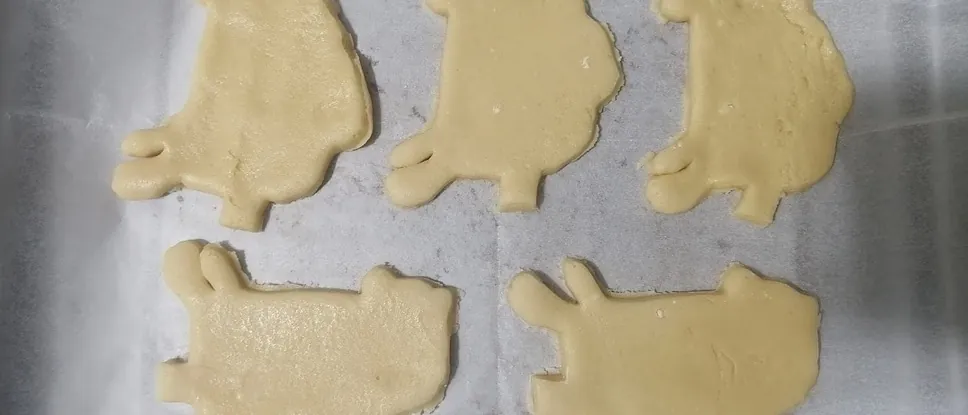
Cookie cutters are the case Prusa is least strict about. They touch dough briefly, at room temperature, and the cutting edge is the only part in contact. Prusa's food safety article calls them possibly acceptable but says to throw them away after some use, because food and bacteria build up in the layer lines. It does not recommend printed water bottles at all.
Heat: hot drinks, dishwashers and cars
PLA softens at a temperature a kitchen reaches easily. Bambu Lab's data sheet for PLA Pure gives a glass transition of 55 °C, heat deflection at 56 °C under 1.8 MPa and 60 °C under 0.45 MPa, and a Vicat softening point of 63 °C. Prusa's PLA article says the material gets soft and deforms above 60 °C.
| Item | Temperature | Source |
|---|---|---|
| PLA Pure glass transition (DSC) | 55 °C | Bambu Lab data sheet |
| PLA Pure heat deflection, 1.8 / 0.45 MPa | 56 / 60 °C | Bambu Lab data sheet |
| PLA Pure Vicat softening | 63 °C | Bambu Lab data sheet |
| Bambu Lab limit for printed parts | 60 °C | PLA Pure product page |
| PLA softens and deforms | Above 60 °C | Prusa knowledge base |
| Cabin air, cars parked in sun about 1 h, Arizona | 40.2-52.2 °C | Vanos et al. 2018 |
| Dashboard surface, same trials | 46.7-85.0 °C | Vanos et al. 2018 |
| Seat surface, same trials | 45.6-63.3 °C | Vanos et al. 2018 |
Water from a kettle that has just boiled is far above that, so a printed PLA mug softens where the drink touches it. The same applies to the dishwasher. Polymaker's wiki warns that prints which look fine at room temperature can "deform, leach, or degrade after dishwasher cycles", and Prusa's blog rules out dishwashers, microwaves and hot soup even for prints that have been coated.
Car cupholders are a common complaint on printing forums, and the 2018 study by Vanos and colleagues in Tempe, Arizona, shows why. With outdoor air at 33-42 °C, the air in parked cars reached 40-52 °C within about an hour, dashboards 47-85 °C and seats up to 63 °C. A PLA cupholder in that cabin spends hours at or above its 55 °C glass transition, and near the dashboard or on a seat it passes the 60 °C at which Prusa says PLA deforms.
Brass nozzles, lead and the hotend
Most printers ship with a brass nozzle, and Prusa points out that the alloy contains lead. Rindelaub's group measured lead in water extracts of their printed blocks. Parts printed through steel nozzles gave 0.60-0.69 ng of lead per block, and parts printed through brass gave 4.95-7.37 ng, roughly 7 to 12 times as much. No lead was found in extracts of the unprinted filament. Annealing the brass printed PLA at 100 °C for 18 minutes cut the lead to 4.95 ng and the total semi-volatile extractables by 43%. The amounts are tiny, and the study was about medical devices, so it does not say whether they matter for food. It does show that the nozzle adds something the spool did not contain.
Prusa's blog extends the warning to its own hardened steel nozzles, which it says may also carry lead in the alloy. Its food safety article suggests a stainless steel or titanium nozzle for anything meant for food, and recommends a cold pull to clean the extruder first. Polymaker makes the related point that a nozzle used for other materials can carry them into the next print.
PTFE comes up in the same discussions, because many hotends have a PTFE tube running close to the hot zone. Prusa's blog says PTFE releases a small amount of toxic particles above 240 °C and significant amounts above 260 °C, and concludes it poses no real danger when printing PLA or PETG at normal temperatures. That concern is about fumes during printing. Neither source reports PTFE ending up in the printed part.
Coatings: epoxy and its limits
Prusa calls a coating the only route to a print that is safe for direct food contact, because it turns the grooved surface into a smooth, washable one. It used Efkoresin Art UV, an epoxy certified to EU 10/2011, and its advice is specific. Use a resin certified for food contact, follow the maker's mixing ratio exactly, and let it cure fully, since liquid epoxy is toxic and an under-cured coating can be too, certified or not. Wear gloves and a respirator while working with it. Polymaker's wording is similar: a coating helps only if it is certified for food contact and applied correctly.
Prusa says coated prints are unsuitable for chopping boards, which scratch through the layer, and for anything exposed to heat, naming hot soup, microwave ovens and dishwashers. Chemical smoothing of PLA or PETG needs hazardous solvents such as the chloroform in its cup test, and it leaves small bubbles where bacteria can sit. Prusa also advises against using SLA resin, either to print dishes or as a coating, because most such resins are toxic in both liquid and cured form and the cured surface wears into a fine powder.
Is PETG food safe, and what about PP?
PETG raises the same questions as PLA, with more heat margin. Prusa's knowledge base says the polymer "in itself may be considered food-safe", recommends a food-safe epoxy coat and a clean stainless steel nozzle, and gives a working range for parts below 80 °C. Prusa's food safety article calls uncoloured PETG the safest bet among common filaments while noting that its exact composition is often unclear. The Rindelaub study is a reminder that a pigment can be the main thing that comes out of a PETG part. The 80 °C figure gives more room than PLA for warm water, but not for boiling water.
Polypropylene is used for food storage containers in industry, and Prusa's 2020 blog lists it with PLA and PETG among filaments that should be safe even without certification. It resists chemicals well. It is also hard to print: Prusa describes heavy warping and very poor adhesion to the print surface, and does not recommend it to beginners. ABS and ASA are the ones Prusa singles out as unsuitable for direct food contact.
Single use against repeated use
EU law tests a single-use article and a reusable one differently, and that distinction is a fair guide at home too. A cookie cutter or a stencil for dusting cocoa touches food for minutes, at room temperature, and Prusa's advice to discard cutters after some use fits any item of that kind. Prusa's food safety article suggests another route: use the print only as a mould, with materials and methods suited to food, so that the food never touches the printed plastic.
A cup, a bowl, a water bottle or a storage box meets food every day, gets washed every day and often meets heat. For those uses the documents above all point the same way. Bambu Lab, the one maker whose filament passed repeated-use migration testing, still says its PLA is not for liquids or for temperatures above 60 °C. Prusa and Polymaker both treat an uncoated print as unsuitable, and a coated one as unsuitable for heat or knives.
For a hobbyist who still wants to print kitchen items, the sources support a short checklist:
- Choose a filament whose maker publishes a food contact test or declaration, preferably natural or in a colour the declaration names.
- Print through a clean stainless steel or titanium nozzle that has not been used for other materials.
- Keep the item cold or at room temperature: no hot drinks, no dishwasher, no microwave.
- Coat anything that will be reused with an epoxy certified for food contact, cured as its maker specifies.
- Throw away short contact items such as cookie cutters once the edges or layer lines start to hold residue.
Frequently asked questions
Is PLA food safe?
The resin is: NatureWorks' Ingeo PLA is covered by FDA Food Contact Notification 178 and complies with EU Regulation 10/2011 as a raw material. A printed PLA object is a different matter, because pigments, the nozzle and the grooves between layers are not covered by those approvals. Short, cold contact such as a cookie cutter is a reasonable use; cups, bottles and anything hot or washed in a dishwasher are not.
Is PETG food safe?
Prusa says the PETG polymer may be considered food safe but does not recommend any filament for dishes, because bacteria grow in the layer lines. It suggests a food safe epoxy coating and a clean stainless steel nozzle. PETG tolerates more heat than PLA, with Prusa giving parts a range below 80 °C, which is still well short of boiling water.
Can I put a PLA print in the dishwasher?
No. Bambu Lab's data sheet gives PLA Pure a glass transition of 55 °C and tells users to keep printed parts below 60 °C, and Prusa says PLA deforms above 60 °C. Polymaker warns that prints can deform, leach or degrade after dishwasher cycles, and Prusa rules out dishwashers even for epoxy coated prints.
How do I make a 3D print food safe?
Prusa's approach is to start with a filament whose maker publishes a food contact test or declaration, print through a clean stainless steel or titanium nozzle, then coat the part with an epoxy certified for food contact, mixed and cured exactly as specified. Even then Prusa says the coated part is not suitable for hot food, microwaves, dishwashers or cutting boards.
Are 3D printed cookie cutters safe?
They are the most defensible kitchen use for a print, since contact with dough is brief and at room temperature. Prusa's food safety article calls them possibly acceptable but says to throw them away after some use, because food and bacteria collect in the layer lines. A filament with a food contact declaration and a stainless steel nozzle reduce the other risks.
Do brass nozzles put lead in prints?
A small amount, in one study. Rindelaub and colleagues (PLOS ONE, 2019) found 4.95-7.37 ng of lead in water extracts of parts printed through brass, against 0.60-0.69 ng for steel nozzles, and none in the unprinted filament. The study concerned medical devices and did not judge food safety. Prusa recommends stainless steel or titanium nozzles for food items.
Sources
- NatureWorks: Regulatory affairs (Ingeo food contact status, FCN 178 and 475, EU 10/2011)
- FDA: Inventory of effective food contact substance notifications, FCN No. 178 (polylactide polymers, NatureWorks)
- 21 CFR 176.170, Table 2: conditions of use A to H
- Regulation (EC) No 1935/2004 on materials and articles intended to come into contact with food
- Commission Regulation (EU) No 10/2011 on plastic materials and articles intended to come into contact with food
- Regulation (EU) No 10/2011, Annex V: overall migration test conditions OM0 to OM7 and repeated use testing
- Bambu Lab store: PLA Pure product page (printing tips and food contact notice)
- SGS test reports for Bambu PLA Pure to EU 10/2011, March 2026 (12 reports)
- Bambu PLA Pure technical data sheet
- Prusa blog: How to make food-grade 3D printed models (Kočí, December 2020)
- Prusa Knowledge Base: Food safe FDM printing
- Prusa Knowledge Base: PLA
- Prusa Knowledge Base: PETG
- Prusa Knowledge Base: Polypropylene (PP)
- Polymaker Wiki: Food safety
- Rindelaub J.D. et al. (2019), Identifying extractable profiles from 3D printed medical devices, PLOS ONE 14(5): e0217137
- Hall D.C. Jr. et al. (2021), Bacterial biofilm growth on 3D-printed materials, Frontiers in Microbiology 12: 646303
- Vanos J.K. et al. (2018), Evaluating the impact of solar radiation on pediatric heat balance within enclosed, hot vehicles, Temperature 5(3): 276-292